Professional Standards Council Explained for Psychologists
You've finished a demanding week, opened your CPD record, and realised that several activities are still sitting in your inbox, calendar, or memory. Then an AHPRA audit notification arrives. You know you completed the learning, but you're less certain about the reflection, the evidence, or whether your portfolio matches the Board's wording.
That anxiety often gets made worse by a second problem: Australian professional regulation uses several bodies with different jobs. A search for “Professional Standards Council” can lead you towards information about schemes, associations, consumer protection, registration, CPD, and audits, without clearly showing where one system ends and another begins.

For psychologists, the practical distinction matters. The Professional Standards Councils operate at the level of professional associations and Professional Standards Schemes. The Psychology Board of Australia, supported administratively by AHPRA, deals with the registration obligations of individual psychologists.
A useful starting point: your registration records must show what you did, why it was relevant to your practice, and how it connects with the Board's requirements.
This guide separates those regulatory jobs, explains what a scheme does, and maps the distinction back to the records a psychologist needs to maintain. The aim isn't to make you memorise another layer of bureaucracy. It's to help you answer a simple question when an audit email appears: which obligation applies to me, and what evidence will demonstrate that I met it?
When Audit Anxiety Meets Confusing Regulation
An audit email can make separate obligations feel like one demand. A psychologist may belong to an association involved in a Professional Standards Scheme while holding individual registration governed by the Psychology Board of Australia. These arrangements can affect the same practice, but they serve different legal purposes.
The confusion has a practical cause. Professional associations may offer CPD, supervision resources, ethics guidance, and professional support. AHPRA may contact you about registration renewal or an audit. The Board sets registration standards and professional expectations. The Professional Standards Councils oversee the scheme framework used by associations to manage professional liability and standards.
A simple record example shows the boundary. A Board audit may ask for evidence supporting your renewal declaration, such as a CPD portfolio and written reflection. A scheme-holder association has separate reporting and risk-management duties under its Professional Standards Scheme. Your reflection can support your registration record, but it is not the association's Annual Professional Standards Report.
Assign each obligation to its owner:
- Individual psychologist: registration, CPD, professional conduct, and audit evidence.
- Scheme holder association: risk management, scheme participation, annual reporting, and member coverage.
- Professional Standards Council system: approval, monitoring, and enforcement of schemes.
- AHPRA: administrative support for the national registration system and audit processes.
The distinction works like a building code and an individual licence. The scheme framework sets conditions for participating professionals and associations. Registration requirements apply directly to you. Meeting one does not prove that you have met the other.
For your personal records, use the Psychology Board's applicable standards and guidance as the reference point. Record what you completed, why it related to your practice, and which supporting document verifies it. Keep dates, activity categories, reflections, and evidence together so an auditor can follow the trail without reconstructing it from memory.
You do not need one file for every regulator. You need a record system that separates scheme responsibilities from registration obligations and preserves evidence for each.
What the Professional Standards Council Actually Is
A psychologist may hear “Professional Standards Council” and assume it is another name for the Psychology Board. It is not. Australia has a national system of eight independent statutory councils, with one council in each state and territory. Together, the Councils work with a national regulatory support agency to approve, monitor, and enforce Professional Standards Schemes. Their statutory role includes consumer protection and professional standard setting.
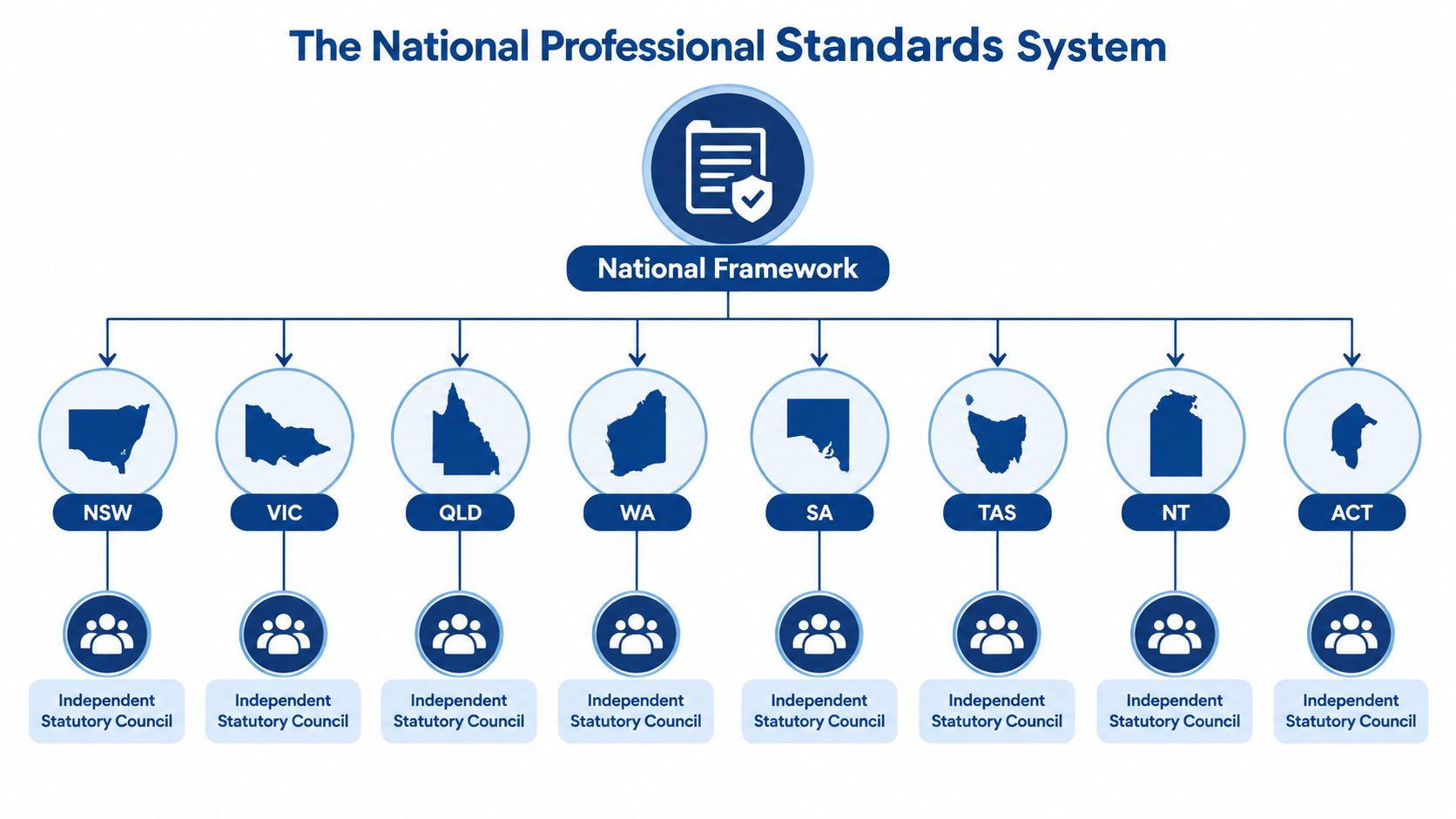
The structure is easier to understand through a building comparison. A building code sets conditions for safer work across a profession. An individual builder's licence confirms that one person is authorised to work and has met personal requirements. A Professional Standards Scheme operates more like the code. Psychology registration operates more like the individual licence. Both support public confidence, but satisfying one does not satisfy the other.
A Professional Standards Scheme can limit the civil liability of participating professionals, subject to stated conditions. The association or other scheme participant then accepts duties involving professional standards, risk management, disclosure, complaints, and reporting. The Council system supervises that arrangement. It does not become the registration authority for every individual member.
Why the state and territory structure matters
Australia's model developed through state and territory legislation, rather than one replacement law. An early milestone was the formal establishment of the NSW Professional Standards Council in 1995, after assent of the Professional Standards Act 1994. Council annual reports are tabled in state and territory parliaments, with reports publicly available back to 2006–07. This gives the system a long institutional record and a visible accountability trail. The 2023–24 annual report describes the national system and its scheme coverage.
The framework had 18 schemes in force by 2023–24, covering 97,853 association members, compared with 95,187 in the previous year, according to the annual report. These figures do not represent all psychologists or the total number of registered psychologists in Australia. They show the reach of a national framework administered through state and territory councils.
The reported coverage increased from 77,885 members in 2018–19 to 86,089 participants at 30 June 2021, 95,187 at 30 June 2023, and 97,853 at 30 June 2024, as recorded in the NSW Professional Standards Council annual report and later national reporting. The increase from 77,885 to 97,853 was about 25.8% over roughly five years. It indicates continuing institutional expansion, rather than a small advisory initiative.
For a psychologist, the practical boundary is clear. If your association participates in a scheme, that scheme may influence the association's governance and risk controls. Your personal registration still depends on meeting PsyBA and AHPRA requirements.
How the Council System Differs From PsyBA and AHPRA
The fastest way to reduce confusion is to identify the regulated subject. The Professional Standards Council system regulates schemes and participating associations. The Psychology Board regulates individual registration standards for psychologists. AHPRA supports the administration of the national registration and audit system.
| Regulatory Body | What It Regulates | Who It Applies To | Where to Go With Questions |
|---|---|---|---|
| Professional Standards Councils | Professional Standards Schemes, their approval, monitoring, and enforcement | Scheme holder associations and participating professional groups | Ask about scheme operation, association obligations, or scheme status through the relevant Council system |
| Psychology Board of Australia | Registration standards, professional practice standards, competencies, and CPD requirements | Registered and provisional psychologists | Ask about registration, CPD, standards, professional obligations, or Board expectations |
| AHPRA | Administration of registration processes and audits on behalf of the National Boards | Registered health practitioners and applicants | Respond to audit or registration correspondence and use AHPRA channels for administrative questions |
| Scheme holder association | Its own scheme participation, risk management, member reporting, and professional support | Members covered by the relevant scheme | Contact the association about membership, scheme participation, evidence, and association requirements |
The Board's role is individual and profession specific. Its registration standards describe the baseline for practice, including continuing professional development. AHPRA then administers processes such as renewal and audit. When an audit request arrives, the question is usually whether your records support the declarations you made about meeting registration requirements.
The Council system addresses a different layer. A participating association may receive the benefit of a scheme only while it meets the scheme's conditions. Those conditions require organisational evidence, not just a collection of individual CPD certificates. The association must show how it manages professional risk and maintains the standards expected under the scheme.
A practical contact test
Ask yourself what the issue is about:
- Your CPD portfolio or registration renewal: start with the Psychology Board and AHPRA.
- A scheme's conditions or association coverage: start with the association or relevant Professional Standards Council channel.
- Professional conduct or registration standards: start with PsyBA and AHPRA, not the Council system.
- Association risk management reporting: start with the scheme holder association.
Psychologists often conflate these systems because associations support both professional development and scheme participation. That overlap creates a record keeping pressure, but it doesn't erase the legal distinction. A clear explanation of AHPRA psychology registration requirements can help keep individual obligations separate from association level arrangements.
What Professional Standards Schemes Require in Practice
A psychology association participating in a Professional Standards Scheme must produce an Annual Professional Standards Report, or APSR. The report explains its risk management strategies, the effect of those strategies, changes made during the year, and material events, including claims or notifications of claims of $500,000 or more. The official APSR guidance describes the reporting requirements.
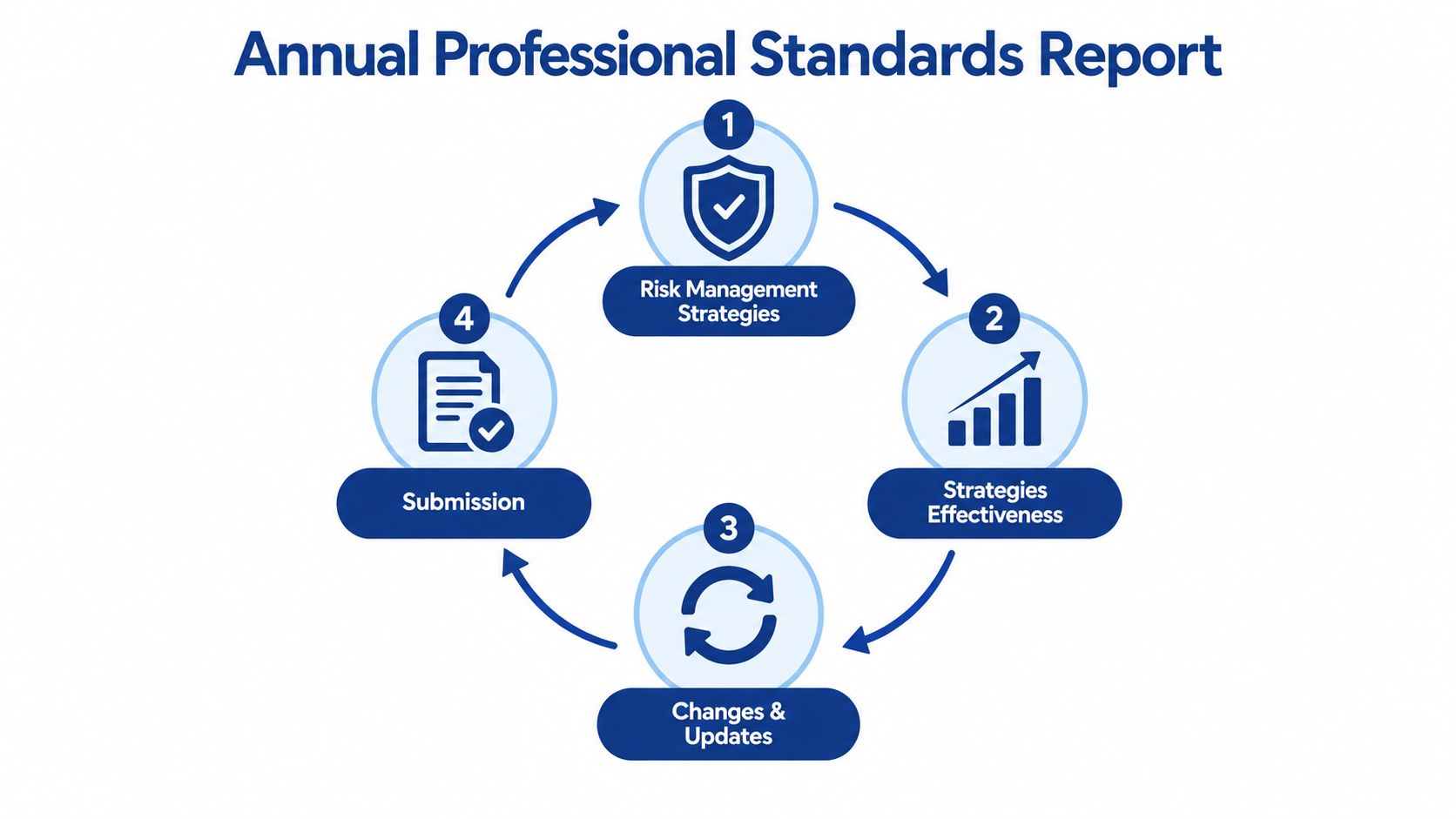
The APSR works as a control loop. The association identifies risks, applies controls, checks whether those controls worked, records changes, and reports the outcome. A statement that a policy exists is weaker than evidence showing how staff used it and what changed as a result.
What this means for psychology organisations
Consider a clinic that receives a complaint about a psychologist's record keeping. Its risk controls might include a documented intake and complaints process, a review by an authorised senior practitioner, an incident record, supervision notes where relevant, and a governance decision about whether the procedure needs updating. The evidence should identify what happened, when it happened, who reviewed it, what action followed, and where the supporting records are stored.
That approach gives an association or employer an audit-ready trail without turning every file into a narrative. Relevant evidence may include complaints handling records, CPD evidence, supervision documentation, incident responses, and governance reviews. The records should be accurate, access-controlled, and consistent with privacy obligations.
The individual psychologist still answers to PsyBA requirements. A Professional Standards Scheme concerns the participating organisation's risk controls and reporting. Psychology registration concerns the practitioner's competence, conduct, continuing professional development, and professional practice. These layers can overlap in the same incident, but they remain separate sources of obligation.
For example, an association may report how it manages complaints across member services. The psychologist involved must separately maintain records that support their own registration declarations and professional decisions. One system does not replace the other.
The Councils' annual report shows the scale of the broader scheme system. That scale explains why participating organisations need documented controls, while psychologists working within them should keep personal registration evidence distinct from organisational governance records.
Compliance Obligations and Audit Triggers for Psychologists
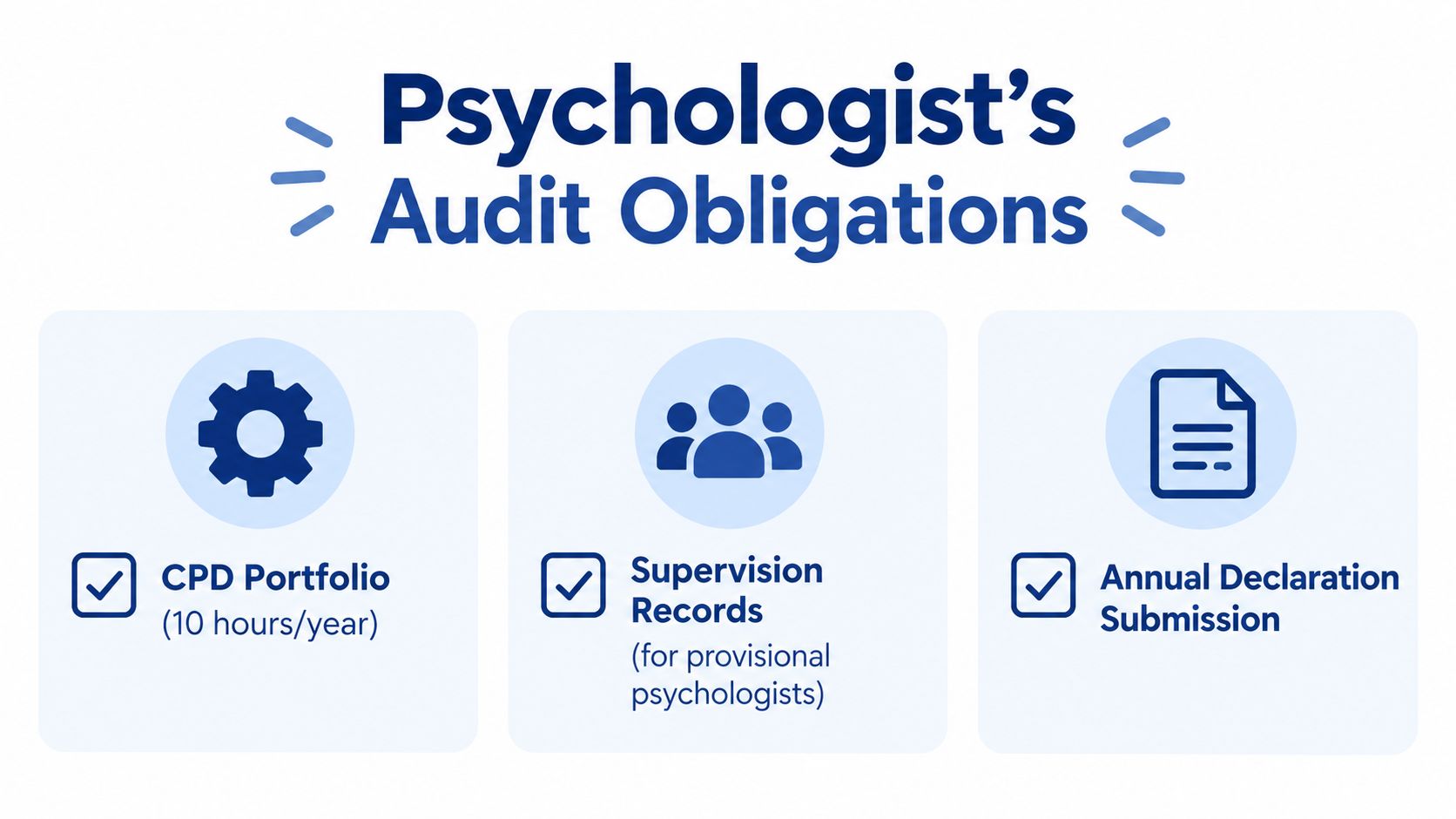
A renewal declaration can feel routine until AHPRA requests evidence. At that point, a psychologist needs a clear trail from identified learning needs to completed activities, reflection, and supporting records. The record should follow the Psychology Board's CPD requirements, rather than the documents that happen to be easiest to download.
The Board's CPD portfolio includes:
- A learning plan: based on objective self-assessment.
- Peer consultation: at least 10 hours annually.
- Other CPD activities: at least 20 hours annually.
- Audit submission: the complete portfolio must be provided to AHPRA within 28 days if selected for audit.
These requirements appear in the Psychology Board's CPD guidance. A learning plan should connect identified development needs with selected activities. A list of webinars may prove attendance, but it does not necessarily show how self-assessment shaped the plan.
Reflection does not need to be lengthy or academic. The AHPRA audit guidance explains that auditors look for written reflection, not a particular word count.
Reflection principle: record what you learned and how it relates to your practice. Length alone does not make reflection stronger.
For example, a reflection might identify a new intervention concept, connect it with a client group or clinical task, and state one change you will make in practice. It should exclude identifying client information while remaining specific enough for another reader to understand its professional relevance.
What an audit may ask you to prove
The Australian Psychological Society's registration standards information explains that CPD audits verify declarations made at renewal. Supporting evidence may include attendance certificates, proof of association CPD compliance, postgraduate transcripts, or research outputs.
Keep more than the certificate. Store the activity date, provider, category, learning objective, reflection, and evidence together. For peer consultation, record the consultation clearly and protect confidentiality. For a fuller walkthrough of what auditors may request, see our guide to audit and assurance.
Use current Board language in your templates and portfolio. Older forms can preserve outdated categories or assumptions, so compare them with the requirements currently applying to your registration.
Practical Steps to Stay Audit Ready Every Week
Audit readiness is mostly a workflow problem. The record you create close to the activity is clearer than the record you reconstruct months later from memory, bank statements, and scattered email attachments.
Start with the smallest useful entry. After client contact, supervision, or professional learning, record the date, activity type, duration, and relevant practice context. Avoid copying identifying client details into a CPD or supervision log. Use a neutral reference that allows you to understand the activity without compromising privacy.
A weekly rhythm for supervisees
A provisional or intern psychologist can keep a single rolling logbook for practice hours, supervision, and education. At the end of each week:
- Capture practice activity: enter client contact and related professional work while the details are still fresh.
- Record supervision: note the date, format, focus, and agreed follow up actions.
- Update CPD categories: separate peer consultation from other CPD activities so totals remain visible.
- Add evidence immediately: attach certificates, attendance records, notes, or relevant supporting documents.
- Write the reflection: record what changed in your understanding or intended practice.
A supervisor needs a slightly different view. They need to review patterns, identify missing entries, confirm that records are coherent, and sign off where required. A live record is more useful than a document produced only at renewal because it allows the supervisor and supervisee to discuss gaps during ordinary supervision.
A practical rhythm for supervisors
Review the logbook at an agreed regular interval. Check whether the entries are dated, whether supervision records identify decisions and follow up, and whether the CPD record distinguishes the learning plan from completed activities. Where your supervision framework uses 1:17 and 1:18 ratio checks, monitor those ratios as activity is entered rather than calculating them retrospectively.
You can also produce a concise summary for a supervision meeting. A useful summary should show practice hours, supervision, education, CPD categories, peer consultation totals, and outstanding evidence. For registered psychologists, a CPD dashboard can separate the learning plan, activities, reflections, and supporting documents.
If you previously used university systems such as placementreview.net, continuity matters. Your professional record shouldn't reset when you move from placement into registration. Keeping the same disciplined habits reduces the chance that early records become a separate, incomplete archive.
For learning decisions, use the Board's requirements as the organising frame, and use resources such as CPD health courses for psychologists to identify education that fits your practice needs. PracticeReady can support this workflow with Quick Log, supervision and education records, CPD category tracking, ratio monitoring, and PsyBA formatted six month reports.
Bringing It All Together for Confident Practice
The Professional Standards Council system is the scheme level structure. PsyBA and AHPRA are the individual registration structure. One doesn't replace the other, and belonging to an association involved in a scheme doesn't transfer your personal registration obligations away from you.
For daily practice, the distinction becomes useful when you organise evidence. Keep association or workplace governance records separate from your own registration portfolio, while ensuring both are sufficiently dated, clear, and reviewable. Your CPD portfolio should show objective self assessment, relevant learning, peer consultation, other CPD activities, reflection, and supporting evidence in the language used by the Board.
Take this question to your next supervision session:
Can I show, without reconstructing it from memory, what I learned, why it mattered to my practice, and what evidence supports it?
If the answer is no, create one record today. Add the date, activity, learning need, reflection, and evidence location. That small habit is more valuable than a last minute administrative rescue, and it gives you a clearer professional record for supervision, renewal, and audit.
PracticeReady provides structured records for practice hours, supervision, CPD activities, reflections, peer consultation, and audit summaries, helping Australian psychologists keep their documentation aligned with PsyBA and AHPRA expectations. If you want to replace scattered spreadsheets with an organised audit ready workflow, visit PracticeReady.