Medical Negligence Definition for Psychologists in Australia

You're halfway through a busy clinic day when a complaint notification arrives. Your stomach tightens. You open the file looking for the risk formulation, the supervision entry, or the consent discussion that would show why you made the decision you did. Instead, you find a few brief progress notes, a template with several blank fields, and a memory that feels clearer than the record.
For psychologists, that moment is where the medical negligence definition becomes practical. A complaint handled by AHPRA, an insurer's investigation, or a state health complaints commission won't rely on what you intended to do. The reviewer will examine whether you owed a duty, whether your care fell below the expected standard, whether that shortfall caused harm, and whether the harm is legally compensable. The Australian Government Actuary estimates that roughly 2,000 negligence claims each year may be expected in relation to private medical practice, although claims are not the same as all adverse events or poor outcomes (Australian Government Actuary medical negligence report).
That's why a defensible psychology record matters. It gives another person a way to follow your assessment, your reasoning, the information you provided, the supervision you sought, and the changes you made when the client's circumstances shifted.
The Moment a Complaint Lands
The notification rarely arrives at a convenient time. You may be between sessions, writing a referral letter, or trying to finish your notes before the next client. The email subject line looks formal. You read it once, then again, searching for the detail that will tell you how serious the matter is.
A registrar I supervised once described this stage as “trying to remember a whole treatment plan from one sentence”. That's a common reaction. The mind goes straight to the session itself. What did the client say? What did I ask? Did I discuss safety planning? Did I recommend medical review? Was supervision recorded?
Then the file takes over. You search for a risk assessment and find a general statement that the client was “safe today”. You look for the reasoning behind a referral and see only “discussed options”. You remember explaining treatment risks, but the consent form records little more than a signature. The problem isn't necessarily that the clinical decision was unreasonable. The problem is that the record may not show how you reached it.
Practical rule: A reviewer can assess the care you documented. They can't reliably assess reasoning that exists only in your memory.
AHPRA may be involved if the concern relates to professional conduct, competence, or suitability to practise. A complaints commission may assess the matter through a public protection lens. In New South Wales, the Health Care Complaints Commission is an independent body responsible for assessing, investigating, prosecuting, and resolving complaints, with public health and safety as its paramount consideration (NSW Health Care Complaints Act).
Those processes aren't identical to a civil negligence claim. They can still expose the same weaknesses in a clinical record. If the file doesn't show what you assessed, what you explained, or how you responded to risk, another person may fill the gap with assumptions.
The legal definition gives you a useful discipline. It asks you to connect your relationship with the client to the standard of care, your actual decision to that standard, and the decision to any injury or loss. The rest of this guide translates those mechanics into the everyday record a psychologist keeps.
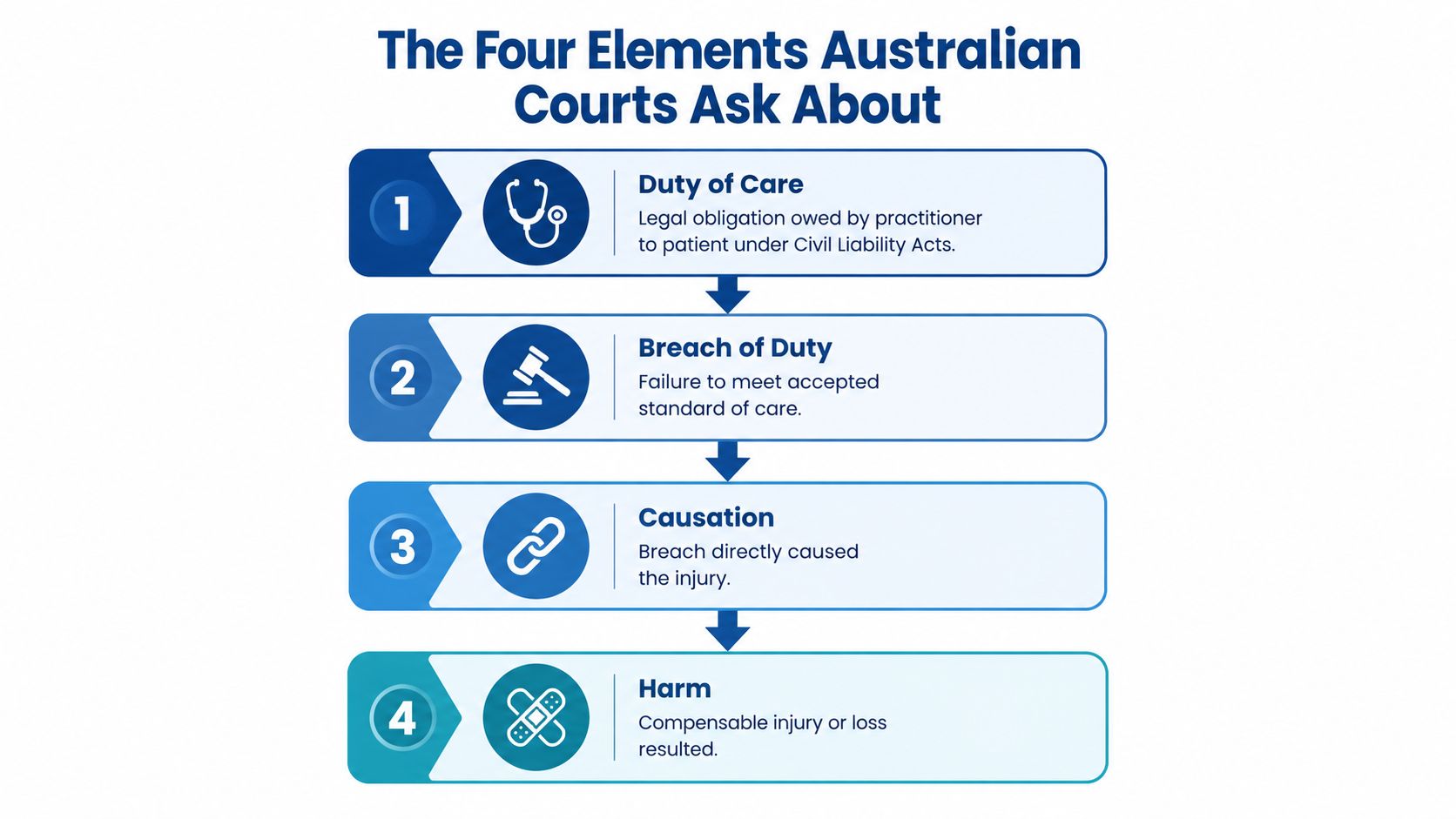
The Four Elements Australian Courts Ask About
Australian negligence law is shaped by state and territory Civil Liability Acts. Those Acts codified important parts of the negligence framework, but they didn't invent the underlying tort. Australian guidance generally describes a claim through duty of care, breach, causation, and damage, with causation requiring its own analysis (Australian medical negligence overview).
Duty of care
A duty usually begins when a psychologist and client enter a professional relationship. The duty covers more than the intervention delivered in the therapy room. Australian authority describes medical professionals as owing a duty extending across examination, diagnosis, treatment, and information provision, an approach associated with Rogers v Whitaker (discussion of Rogers v Whitaker).
For a psychologist, that may include taking an adequate history, considering foreseeable risk, developing a formulation, selecting an appropriate intervention, explaining material risks, monitoring progress, and responding to new information. Ending sessions doesn't automatically erase responsibilities created by the existing relationship. Your records should show how you managed transition, referrals, follow up, and any unresolved risk.
Breach of duty
Breach asks whether your care fell below what a reasonably competent practitioner would have provided in the circumstances. The question isn't whether another psychologist would have used a different phrase, worksheet, or therapeutic style. It's whether the decision was outside the range of reasonable professional care.
The older English case Bolam v Friern is often discussed in relation to the reasonable practitioner standard. Australian law didn't adopt a rule of complete professional deference. In Rogers v Whitaker, the High Court gave particular weight to the patient's right to receive information about material risks, rather than treating professional practice alone as decisive.
Causation
A mistake isn't enough. The claimant must connect the alleged breach to the harm. Australian Civil Liability frameworks distinguish factual causation, whether the breach was a necessary condition of the harm, from scope of liability, whether it's appropriate to hold the practitioner responsible for that harm (Australian causation analysis).
In practice, the question might be whether a missed risk assessment led to a failure to arrange a necessary response, and whether that failure contributed to the injury. A client's deterioration after treatment doesn't establish causation by itself.
Damage
There must be actual injury or loss that the law recognises as compensable. A disappointing therapeutic result, a difficult session, or a client's dissatisfaction may be important clinically without amounting to legally compensable damage.
All four elements must be established on the balance of probabilities. The Australian medical negligence explainer for psychologists puts the framework into a psychology setting, including standard of care, causation, informed consent, risk management, and documentation.
What Standard of Care Means for a Psychologist
The standard of care isn't a demand for perfect practice. It's a question about what a reasonably competent psychologist, with comparable training and registration, would have done in the same circumstances. Your documentation helps the reader understand those circumstances, rather than judging a decision with the benefit of hindsight.
Examination and assessment
Assessment means more than completing an intake form. It may involve relevant history, current presentation, functional impact, risk screening, collateral information where appropriate, and suitable measures. You don't need to turn every session into a formal report, but the record should show what information mattered and how it influenced your plan.
Formulation and diagnosis
A diagnosis should be reasoned rather than copied forward automatically. If new information changes your understanding, record the revision and its clinical implications. A concise note can be enough when it identifies the evidence, the uncertainty, and the decision that followed.
Treatment and intervention
Treatment should be evidence informed, within scope, and responsive to the client's progress. A defensible treatment plan explains the intended target, the intervention selected, how progress will be reviewed, and what you'll do if the approach isn't helping. AHPRA's Code of Conduct resources and registered health practitioner guidance provide the professional context for these expectations.
Information giving
Consent isn't reduced to a signed form. Rogers v Whitaker remains especially relevant when an intervention carries a material risk that a reasonable person in the client's position would consider significant. Discuss likely benefits, relevant adverse reactions, alternatives, and the client's questions, then record the discussion in plain language.
| Clinical Stage | Expected Standard | Documentation Evidence |
|---|---|---|
| Assessment | Relevant history, presentation, risk, and measures inform care | Key findings, screening completed, limits of information |
| Formulation | Clinical reasoning connects information to the working understanding | Formulation, differential considerations, changes over time |
| Treatment | Intervention is appropriate, within scope, and reviewed | Goals, rationale, response, adaptations, review points |
| Information giving | Material risks, alternatives, and questions are addressed | Consent discussion, client understanding, decisions made |
A record that shows this sequence makes your decision intelligible to someone who wasn't in the room. For a broader governance perspective, compare your workflow with the National Safety and Quality Health Service standards, while remembering that psychologist obligations also arise from registration standards, ethical duties, and applicable law.
Scenarios That Look Like Negligence in Practice
Consider a client who discloses suicidal thoughts. The note records the disclosure but doesn't show any inquiry about plan, means, timing, intent, protective factors, or immediate supports. The client later experiences serious harm.
The allegation would begin with duty. Breach might be argued if a competent psychologist would have completed and documented a more detailed risk assessment in those circumstances. Causation would still need proof that the omission contributed to the harm, and the claimant would need to establish compensable damage. A thin note doesn't prove negligence, but it makes a reasonable clinical response difficult to demonstrate.
Now consider a registrar working independently with a client presenting with complex trauma, dissociation, and escalating risk. The supervisor knows the case is difficult, but the supervision record says only “general case discussion”. There's no documented differential diagnosis, risk formulation, agreed treatment boundary, or plan for further supervision.
Here, the issue isn't that a registrar can't work with complexity. The concern is whether the practice arrangements, supervision, and clinical decisions matched the registrar's level of competence and the client's needs. Clear supervision notes can show that the risks were identified, options were weighed, and the supervisor gave specific direction.
A third client is offered EMDR. The psychologist explains the broad purpose but doesn't record discussion of possible adverse reactions, alternative modalities, or the client's questions. The client later reports distress and says they didn't understand what the treatment might involve.
That may raise an informed consent concern. The legal question remains whether the risk was material, whether adequate information was provided, and whether the lack of information caused actionable harm. A signed form won't answer those questions if the conversation itself is absent.
The strongest record doesn't claim that nothing could go wrong. It shows that you recognised what could go wrong and acted reasonably.
Negligence Is Not the Same as a Bad Outcome
Psychologists often use “something went wrong” to describe several different processes. Legal outcomes improve when you separate them.
An adverse event can occur despite reasonable care. A client may deteriorate, reject a treatment, experience an expected reaction, or face circumstances outside the psychologist's control. Negligence requires more than the timing of harm after treatment. It requires a failure to meet the expected standard and a causal connection to injury or loss (Australian guidance on medical negligence).
An AHPRA complaint asks a different question. It may concern professional conduct, competence, health, or suitability to practise. A health complaints commission also focuses on public protection and may investigate conduct without determining whether a civil damages claim has been proved.
Mandatory notifications have their own threshold and purpose. They relate to matters such as impairment, notifiable conduct, or a significant departure from accepted standards, rather than automatically arising from every adverse outcome. A psychologist should obtain specific advice about the applicable notification obligation instead of treating a complaint as proof that notification is required.
A coronial finding examines a death and may address causation, contributing circumstances, and prevention. It doesn't, by itself, establish civil breach or create an entitlement to compensation.
| Process | What it tests | Forum | Standard | Possible outcome |
|---|---|---|---|---|
| Negligence claim | Duty, breach, causation, and compensable damage | Civil court or pre court process | Balance of probabilities | Damages, settlement, or dismissal |
| Complaint | Professional conduct, service, or public safety concerns | AHPRA or health complaints commission | Statutory and regulatory criteria | Investigation, restrictions, prosecution, resolution |
| Notification | Whether a reportable professional concern exists | AHPRA and the relevant regulator | Mandatory notification threshold | Regulatory assessment or action |
| Coronial finding | Circumstances and causes of a death | Coroner's Court | Coronial statutory framework | Findings and recommendations |
One process can expose evidence relevant to another, but a complaint isn't automatically a negligence claim, and being involved in one process doesn't guarantee that the others will follow.
How an Australian Negligence Claim Actually Moves
The first response to a possible incident is practical, not argumentative. Preserve the record, document any immediate clinical action, and notify your professional indemnity insurer in line with the policy. Don't alter an old note to make it look complete. If you need to add information, make a clearly dated supplementary entry that identifies what it relates to.
The insurer may request records, correspondence, a chronology, and your account of what happened. Cooperate with the investigation, but avoid contacting the client to debate blame or offering an informal explanation before receiving advice. A lawyer or insurer may arrange expert review to assess whether the care was reasonable and whether the alleged harm can be linked to it.
The main stages
- Trigger event: An adverse incident, concern, or injury is identified and recorded.
- Insurer notification: The practitioner contacts the indemnity insurer under the policy requirements.
- Preliminary assessment: Records, timelines, and expert opinions are reviewed.
- Formal claim: A demand or other formal notice sets out the allegation and response process.
- Negotiation or mediation: The parties may discuss resolution or use alternative dispute resolution.
- Resolution: The matter settles or proceeds to a court determination.
The relevant court, pre court requirements, and limitation rules depend on the state or territory and the type of claim. Civil Liability legislation and the applicable Limitation Act can impose procedural steps and deadlines, so a psychologist shouldn't rely on a generic online timeline.
Australian medical negligence data gives useful context without predicting an individual psychology matter. Most claims settle for under $100,000, while the most serious cases can exceed $1 million, according to an Australian summary citing 2022–23 government actuary data (Australian medical negligence rights summary). Those figures relate broadly to medical negligence and aren't a valuation tool for a psychologist's claim.
This video provides a general visual explanation of how a negligence claim can progress.
Records That Make or Break a Defence
Good records are not defensive theatre. They're part of safe clinical practice, continuity of care, supervision, and accountability. They also give an insurer or expert a way to test whether your decisions were reasonable at the time, rather than reconstructing them from memory after the outcome is known.
The most useful record is specific without becoming bloated. “Risk discussed” tells a stranger very little. “Client denied current intent, identified access to medication, agreed to contact their GP and use the documented support plan if thoughts escalated” gives the reader a clearer account of assessment and response.
Five records worth checking
- Contemporaneous session notes: Record the date, presentation, relevant information, intervention, response, and next step close to the consultation.
- Risk assessment entries: Capture the questions asked, relevant risk and protective factors, formulation, safety planning, referrals, and follow up.
- Supervision records: Show the case issue, options considered, advice given, decisions made, and any agreed review or escalation.
- Consent discussions: Document material risks, alternatives, expected benefits, questions, and the client's decision. A form can support the record, but it can't replace the conversation.
- Treatment plans: Link goals to interventions and include clear points for reviewing progress, adapting care, or referring elsewhere.
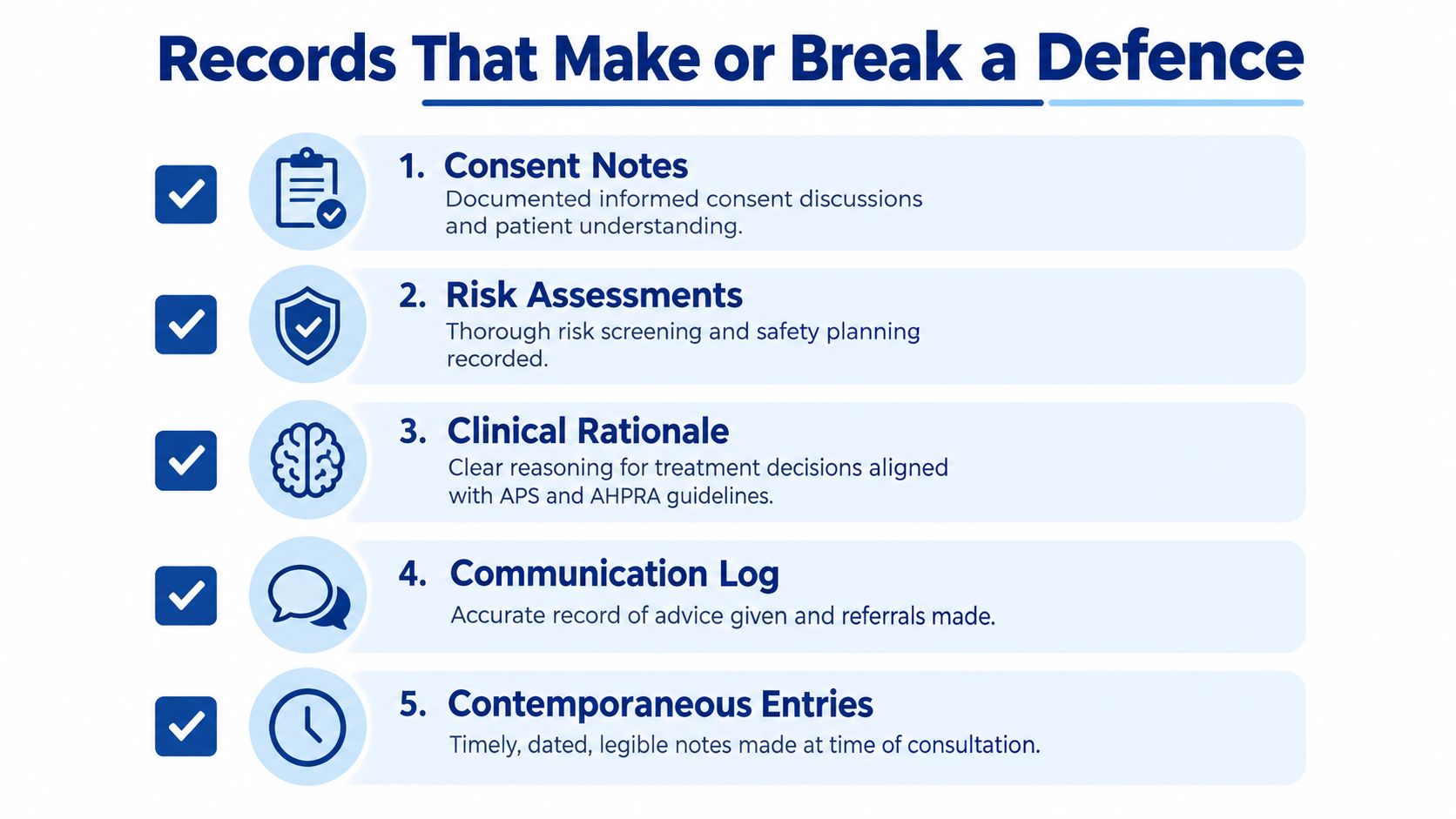
AHPRA's guidance on registered health practitioner obligations should sit alongside your organisation's record policy, privacy requirements, supervision arrangements, and insurer guidance. The aim isn't to write a legal essay after every session. It's to make your clinical reasoning visible.
Use this short audit test from the audit and assurance guide for psychologists: could another competent psychologist understand what you knew, what you considered, why you acted, and what you planned to review? If not, improve the template or the habit, not just the wording in one file.
What to Do Differently Tomorrow
You don't need a complete practice overhaul to strengthen your position. Start with a small review cycle that fits around clinical work and supervision.
Begin with three recent files
Select three files from different stages of care. Look specifically for:
- Consent evidence: Can you see what was explained, including material risks and alternatives?
- Risk reasoning: Does the note show what you asked, what you found, and why the response was proportionate?
- Treatment logic: Can a reader connect the formulation, goals, intervention, and review plan?
- Communication trail: Are referrals, advice, missed appointments, and follow up actions clear?
Don't rewrite historical notes to make them look better. Record a dated addendum only when there's a legitimate clinical reason to add information, and follow your workplace policy.
Tighten supervision records
For registrar work, make supervision notes answer four questions: what was complex, what risks were considered, what advice was given, and what the registrar will do next. A brief entry can still be meaningful if it captures the decision rather than merely naming the case.
Rehearse the first response
Review your incident procedure while the practice is calm. Know who receives the initial report, when the insurer is contacted, how records are preserved, how the client's immediate care is managed, and who provides legal or clinical advice. You're not trying to predict every event. You're reducing the chance that panic creates a second problem.
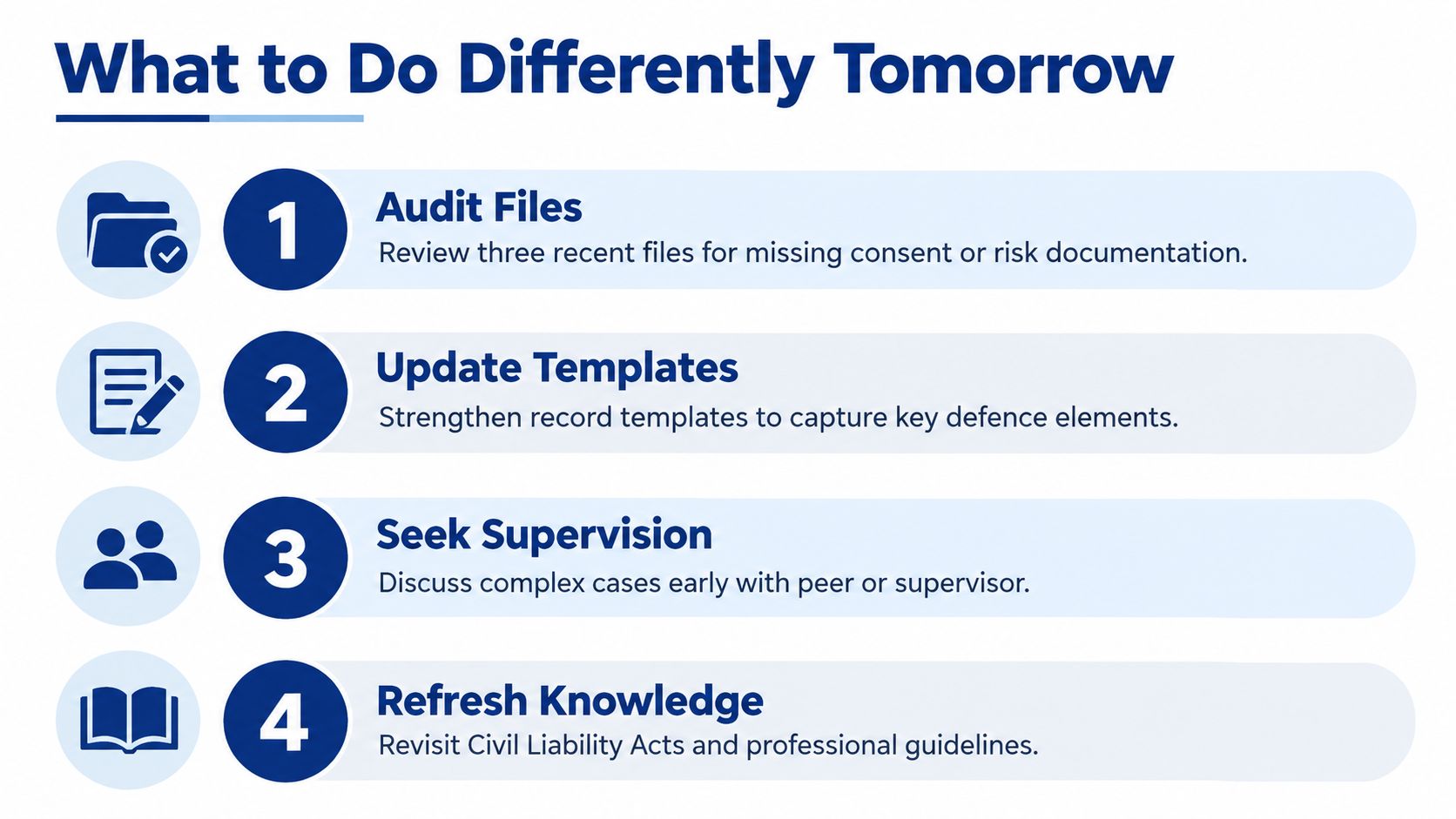
The practical definition is simple enough to remember: reasonable care, clearly recorded, connected to the client's circumstances. Review one small group of files each week, discuss uncertainty early in supervision, and treat documentation as part of the intervention rather than paperwork after it.
PracticeReady helps Australian psychologists capture client contact, supervision, CPD, risk related records, and audit evidence through structured workflows aligned with PsyBA and AHPRA expectations. Visit PracticeReady to see how it can help keep your professional records organised and ready for review.