Negligence of Duty of Care in Psychology: A Practical Guide

You're halfway through a busy week when an email arrives about a former client. The client ended therapy eighteen months ago. You remember the broad clinical picture, but not every decision, referral discussion, risk review or supervision conversation. Your first thought isn't an abstract question about the negligence of duty of care. It's more immediate: Where are the notes, and will they show what I really did?
That anxiety is familiar to psychologists who've worked through notifications or supervised someone who has. A defensible record doesn't need to sound legalistic. It needs to show the clinical question, the information available at the time, the reasoning applied, the action taken and the follow up arranged. Supervision records, consent documentation, risk assessments and CPD reflections complete that picture.
Australian negligence law asks whether a duty existed, whether the standard of care was breached, and whether that breach caused harm. In practice, the evidence usually sits in ordinary professional records. The quality of those records can determine whether a reviewer sees a considered clinical process or an unexplained gap.
The Phone Call No One Prepares You For
The psychologist found out through an email. A former client had lodged a notification about care provided almost two years earlier. The complaint referred to risk, communication and a referral that the client said had never been properly explained.
The first hour followed a predictable pattern. The psychologist searched the electronic health record by surname, then by date of birth, then through archived files. The progress notes were there, but several were short. One recorded that the client was “more distressed” without describing the assessment behind the decision to continue outpatient care. Another mentioned safety planning but didn't identify who had been contacted, what the client agreed to do, or when the plan would be reviewed.
Practical rule: A note should allow another competent psychologist to reconstruct your reasoning without needing your memory to fill the gaps.
The supervisor phone tree started with the principal supervisor, then the practice owner and finally the insurer's notification line. Nobody was asking the psychologist to rewrite history. They were trying to establish the timeline: when the disclosure occurred, what action followed, whether supervision took place, and which records existed before the complaint.
That distinction matters. A retrospective account can explain what you remember, but a contemporaneous note can demonstrate what you considered at the time. A dated risk assessment, a supervision entry naming the issue, a consent form recording the client's questions and a follow up letter can show a connected process. A series of generic entries can leave the same clinical decisions looking unsupported.
What gets located first
The search usually extends beyond progress notes. Reviewers may need to see:
- Risk records: The assessment, protective factors, escalation decisions, safety plan and planned review.
- Supervision evidence: The date of discussion, clinical issue, advice received, decision made and action followed.
- Consent paperwork: The treatment information provided, material risks discussed and the client's questions or preferences.
- Communication records: Letters, referrals, missed appointment contacts and handover details.
- CPD and competency records: Evidence that relevant learning and professional reflection informed practice.
Ahpra describes complaints about unsafe care, unprofessional behaviour or practitioner health as notifications, and its information for practitioners explains the notification process and protections available under the National Law for people who raise concerns in good faith. National reporting has also described the practical burden of delay, with the average duration of Ahpra investigations increasing by 52% between 2018–19 and 2022–23, while one in four investigations lasted more than two years. Those figures are reported in the context of the regulatory system, not as a finding that every notification involves negligence. They do show why records may need to remain intelligible long after the clinical work ended. (Ahpra information about notifications)
The central lesson is uncomfortable but useful. Documentation and supervision evidence are the operational defence. Legal doctrine tells you what must be established. Your records show how you met your professional obligations in a real consultation, with incomplete information, competing risks and time pressure.
The Four Elements Every Psychologist Must Understand
Consider a client who discloses suicidal ideation during a session. The client denies immediate intent but describes increasing hopelessness, access to medication and a recent missed appointment with a treating doctor. The psychologist completes a risk assessment, discusses the case in supervision, sends a follow up letter and records a missed appointment protocol after the client doesn't attend the next session.
That vignette gives us a practical way to examine the four elements. Australian negligence is commonly analysed through duty, breach, causation and harm, with the standard focused on reasonable professional practice rather than perfection. The South Australian Law Handbook guidance on medical negligence explains the importance of the competent professional standard and peer accepted practice. The High Court's reasoning in Rogers v Whitaker is also important because it shaped the patient focused duty owed when a practitioner communicates treatment risks.
Duty
The first question is whether the psychologist owed the client a duty of care. In an established therapeutic relationship, that will usually be straightforward. The more useful question is what the duty required in the circumstances.
The client's disclosure, medication access and missed medical review create a context in which reasonable care may include assessment, consultation, safety planning, communication and follow up. The record should show what information was available and why the psychologist selected a particular response.
Breach
Breach asks whether the conduct fell below the standard expected of a reasonably competent psychologist. A poor outcome alone doesn't prove breach. The file should demonstrate how the psychologist assessed the risk, considered escalation, sought supervision and responded when the client failed to attend.
If the psychologist records only “client denied intent, continue therapy”, a reviewer may struggle to see whether the relevant risk factors were considered. If the entry records the questions asked, protective factors, access to means, consultation, agreed actions and review point, it provides evidence of a structured decision.
Causation and harm
Even where a departure from reasonable care is alleged, the complaint must connect that departure to harm. In the vignette, the question isn't whether the client later deteriorated. It's whether a particular omission, such as failing to arrange follow up or communicate with another treating professional, caused or materially contributed to the loss claimed.
The civil question is determined on the balance of probabilities. A regulatory process under the National Law is different. It may examine professional conduct, competence, risk to the public and compliance with registration obligations, even where a civil claim has not established compensable harm.
Mapping the four elements of negligence to the clinical vignette
| Legal Element | Vignette Moment | Evidence in the File |
|---|---|---|
| Duty | The client disclosed suicidal ideation during treatment | Intake and treatment records, therapeutic relationship, scope of care |
| Breach | The psychologist either did or did not assess risk and arrange reasonable follow up | Risk assessment, clinical reasoning, supervision entry and safety plan |
| Causation | The alleged omission is connected to later deterioration or loss | Timeline, communications, referral records and expert opinion |
| Harm | The client reports a recognised loss or injury | Clinical records, reports, treatment impact and other relevant evidence |
The practical test is therefore not “Did something go wrong?” It's “Can the file show what a competent psychologist knew, considered and did?” A useful companion explanation of the legal components appears in PracticeReady's medical negligence definition, but clinical records still need to carry the case specific evidence.
Where Legal Duty Meets Professional Competency
The legal test and the Psychology Board's competency framework aren't identical, but they meet in everyday decisions. A supervisor reviewing a case is often asking the same operational questions a reviewer or court will later ask: Did the psychologist understand the issue, communicate appropriately, act within scope and recognise when to seek help?
A provisional psychologist is managing a client on a Mental Health Treatment Plan. The client reports worsening sleep and agitation. A medication review flag appears in the record, but the psychologist doesn't raise it in supervision, doesn't clarify the treating doctor's involvement and doesn't document a follow up plan. The client later deteriorates.
Under the National Law, the concern may involve competence, communication, record keeping, supervision or public safety. Under tort law, the analysis asks whether the psychologist owed a duty, departed from the competent standard, and caused harm. The same event can therefore create different processes with overlapping evidence.
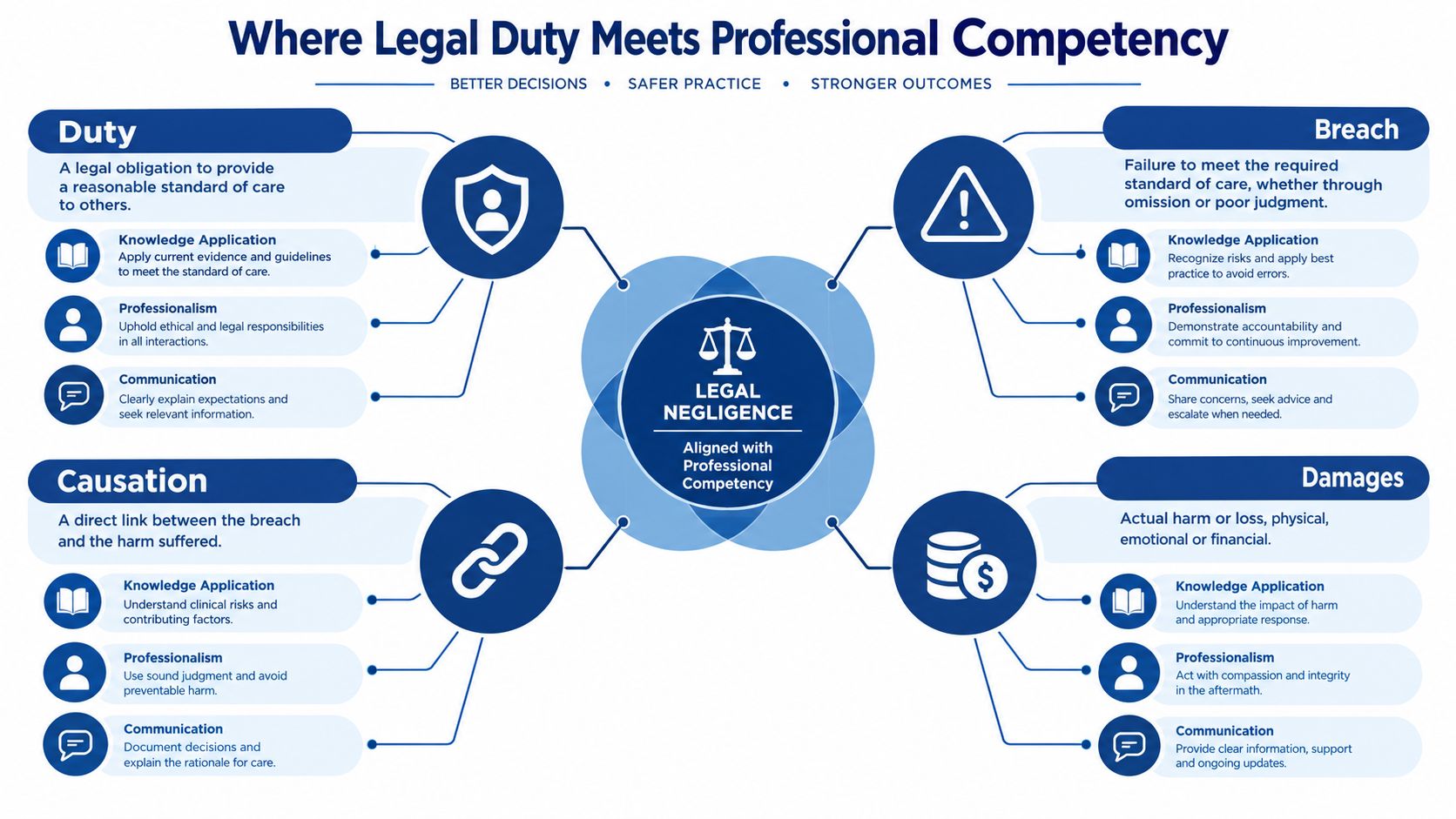
Four competency lenses
Competency 1.1 can be used to examine whether the psychologist applied appropriate psychological knowledge to the presentation. The supervision record should name the clinical information that mattered, not merely state that the case was discussed.
Competency 2.1 brings professionalism into view. Did the psychologist recognise the limits of their role, consult appropriately and respond to the medication issue without stepping beyond their authority?
Competency 3.1 supports the communication analysis. A referral or follow up plan needs clear communication with the client and, where authorised and appropriate, other treating professionals.
Competency 4.4 connects with review and risk management. The psychologist should be able to show how they monitored the client, responded to changed information and adjusted care.
A quarterly supervision review is where these expectations become visible in routine practice. A useful entry might record the medication review flag, the supervisor's questions about deterioration, the agreed contact with the treating doctor, the client communication plan and the date for checking the outcome. That is much stronger than “discussed complex client”.
Supervision notes become legal evidence when they record decisions, not attendance.
The supervisor's note shouldn't predict liability. It should show the reasoning process and the action agreed. A competency based record can therefore serve two functions, evidence of professional development and evidence that the psychologist recognised and managed a foreseeable clinical concern.
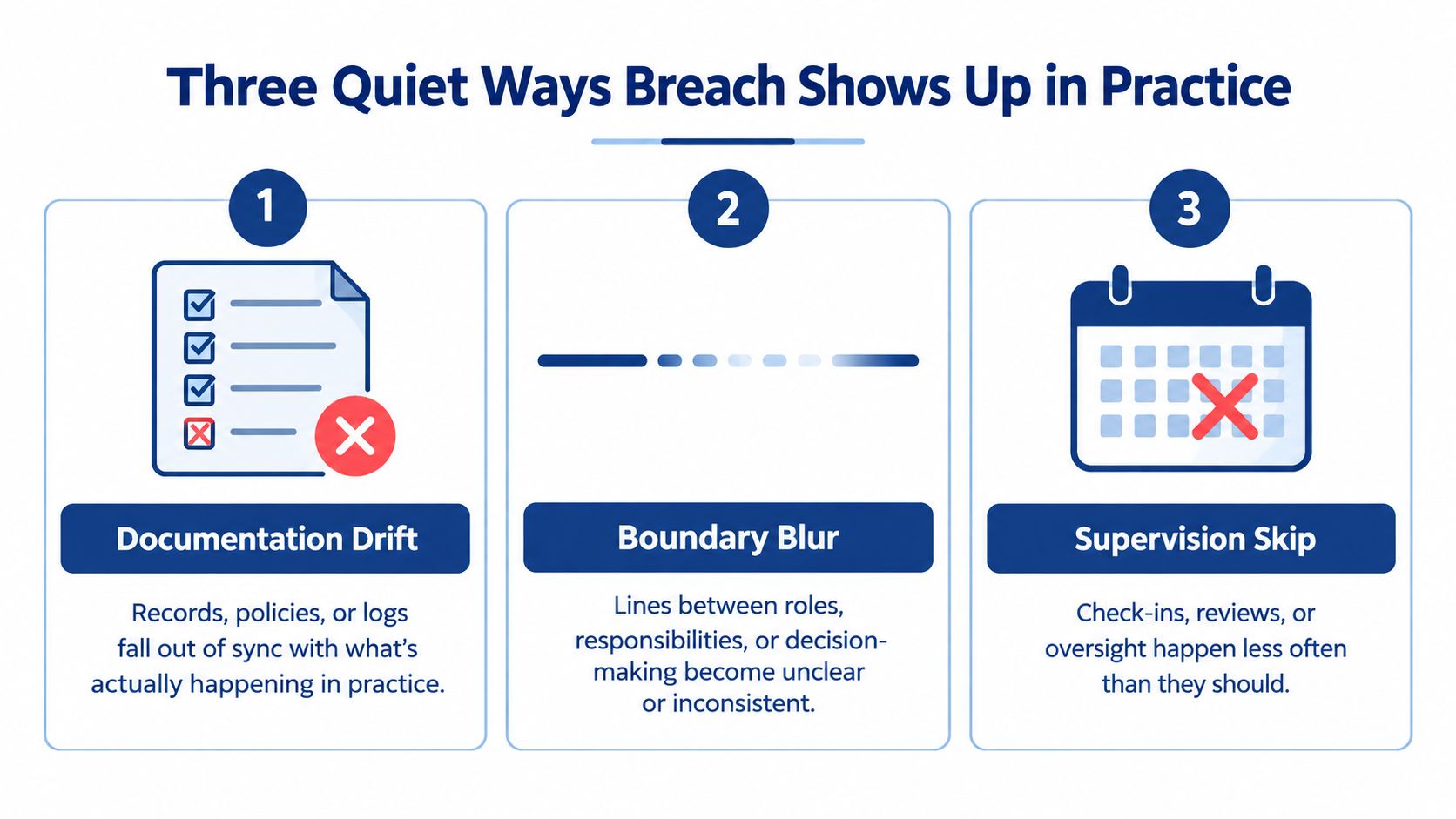
Three Quiet Ways Breach Shows Up in Practice
The most concerning records I review as a senior supervisor rarely contain an obvious admission of careless practice. More often, the breach becomes legible through small omissions that interrupt the clinical story.
Disclosure failure
A consent note may list broad categories such as confidentiality, limits of privacy and possible treatment risks. It doesn't record the client's specific question about information sharing, the explanation provided or the client's decision.
That gap matters because a list of topics doesn't demonstrate a meaningful discussion. A stronger entry records what the client wanted to understand, how the psychologist explained the issue, what uncertainty remained and what consent was given. The Rogers v Whitaker reasoning is particularly relevant to the importance of communicating material risks in a patient focused way, although each psychology matter depends on its own facts.
Missed escalation
A session note says the client is “more hopeless” and has stopped using previously helpful supports. The phrase sits in the record, but it never appears in supervision. No new risk review follows, and no updated safety plan records the client's response.
The issue isn't that every change requires emergency action. The issue is the absence of a documented decision. A reviewer will want to see the assessment, the threshold considered, consultation where needed, communication with the client and the reason for the chosen level of care.
Incomplete handover
A psychologist goes on leave and refers a client to another clinician. The discharge note names the service but not the receiving practitioner, contact date, information transferred or confirmation that the client understood the transition.
That creates uncertainty at the exact point where continuity matters. The Code of Conduct themes relevant to these examples include clear communication, appropriate records, confidentiality, continuity of care, working within competence and responding to risk. The RACGP discussion of foreseeability and reasonable precautions also illustrates why warnings, escalation and structured records matter when a foreseeable risk is being managed.
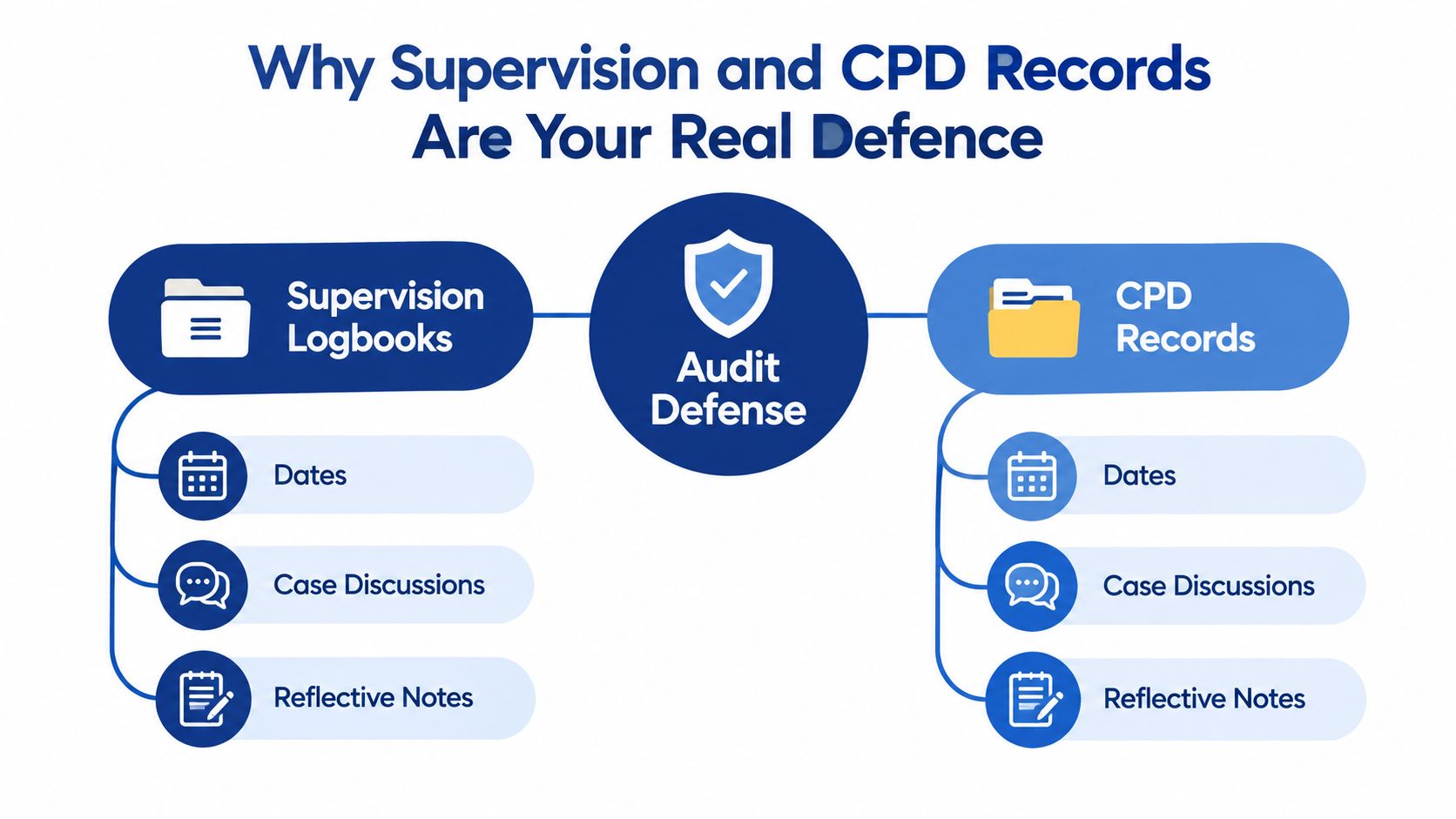
Why Supervision and CPD Records Are Your Real Defence
Many psychologists treat supervision logs and CPD reflections as evidence that an obligation was completed. That's too narrow. In a notification, the useful question isn't only whether supervision occurred. It's whether the record shows competent professional reflection connected to practice.
The Psychology Board requires registered psychologists to complete at least 20 hours of CPD each registration year, including at least 10 hours of peer consultation. The CPD portfolio records learning goals, planned and completed activities, and reflection on how learning improved practice. (Psychology Board CPD requirements)
A vague entry such as “supervision, risk discussed” may prove little years later. A more durable entry identifies the presenting issue, the risk threshold considered, the supervisor's challenge, the decision made and what changed afterward.
What survives time
Consider two entries from an old file.
The first says: “Case review. Continue monitoring.”
The second says: “Discussed increased hopelessness and missed medical appointment. Considered current intent, access to medication, protective factors and capacity to contact the treating doctor. Supervisor advised a documented safety plan and follow up contact. Client agreed to contact the doctor, and psychologist will review attendance at the next appointment.”
The second entry doesn't guarantee that every later decision will be accepted. It does show the sequence of assessment, consultation and action. That sequence helps a reviewer distinguish an isolated judgement call from a pattern of unrecognised risk.
The Board says an audited psychologist must provide the CPD portfolio to Ahpra within 28 days, and CPD records must be retained for five years. (Psychology Board CPD audit requirements) Those requirements make reconstruction a poor strategy. If the record is created months later, it may look defensive. If it's contemporaneous, it can show how learning and supervision informed actual work.
A logbook that says you attended supervision is an attendance record. A logbook that shows how supervision changed your practice is evidence of competence.
Reflective writing should be equally concrete. A useful reflection names the clinical situation, identifies what the psychologist learned, states what will change and records how that change will be checked. The Pendleton feedback model can help supervisors structure feedback, but the record still needs to capture the issue and resulting action in the psychologist's own practice.
Building an Audit Ready Documentation Routine
Good records are easier to create when each entry has a predictable place in the week. The routine below links the clinical note, supervision discussion and CPD reflection without turning documentation into a second clinical service.
Write the session note within 24 hours. Record the clinical reasoning, relevant risk assessment, decisions made, communication, follow up and outcome still to be checked. Don't copy the entire session. Capture the information that explains why the plan was reasonable.
Bring unresolved issues to supervision and complete the supervision entry within 48 hours. For provisional psychologists in the 5+1 internship, Ahpra guidance requires a minimum of 50 hours of total supervision with the principal supervisor. At least 70 hours of supervision must be direct real time communication, no more than 20 hours can be through non visual communication such as telephone, and up to 10 hours can be indirect written feedback. The recommended rate is one hour of supervision for every 17 to 18 hours of psychological practice. (Ahpra supervision guidance)
Review the CPD portfolio monthly. Add the learning goal, activity, reflection and practice change while the connection is fresh. A later audit should be able to follow the thread from clinical uncertainty to supervision, learning and improved practice.
Weekly Audit Ready Documentation Cadence
| Cadence | Artefact | Key Fields | Evidence Element |
|---|---|---|---|
| Within 24 hours | Clinical note | Reasoning, risk, decisions, communication and follow up | Duty and breach |
| Within 48 hours | Supervision entry | Case issue, supervisor feedback, action and outcome | Breach and competency |
| Weekly | Ratio review | Practice hours, supervision mode and hours completed | Regulatory compliance |
| Monthly | CPD portfolio entry | Goal, activity, reflection and practice change | Competence and prevention |
| At handover | Transition record | Receiving clinician, contact date, information transferred and client understanding | Continuity and causation |
A practical system can link these records instead of leaving them in separate spreadsheets, emails and folders. PracticeReady structures evidence trails through quick client contact logging, supervisor ready logbooks, ratio checks, CPD tracking and formatted reports for registration processes. Its audit and assurance guidance reflects the same principle, records should make the professional process visible rather than merely store completed forms.
What to Do Differently This Week
Start with a Monday note audit. Choose several recent files and ask whether each note identifies the risk considered, the decision made, the communication provided and the next review point. If a colleague had to understand the case without your memory, could they?
Use Friday as a CPD checkpoint. Add one reflection that connects learning to a real practice decision, rather than recording only the activity title. For a client whose care crosses a leave or referral boundary, use a handover template that names the receiving clinician, contact date, information transferred, client understanding and follow up responsibility.
Pull your last five supervision entries and read them as a reviewer would. Does each one name a risk discussion, a clinical question and a decision, or do they mainly record case updates?
Map the routine to the relevant competency areas, including 1.17 and 1.18 for professional practice expectations, 3.2 for record keeping and 5.1 for supervision. The exact wording in your current Board documents should guide the mapping, but the practical test is simple: each record should show what you knew, what you did and how you checked the result.
PracticeReady supports audit ready evidence logging for supervision, CPD and professional records.
Questions Practitioners Ask After a Notification
Should I contact the practitioner who made the complaint? Speak with your supervisor, principal and insurer first. Direct contact can affect boundaries, communication and the notification process, so don't improvise a response.
Which supervision entries are likely to matter first? Start with entries connected to the allegation, risk decisions, referrals, consent and any relevant Section 1.17 supervision expectations. A dated discussion with reasoning is more useful than a long logbook with generic topic labels.
What if my notes are thin? Don't backfill or alter the original record. Preserve it, create a clearly dated retrospective chronology if advised, and separate what the record shows from what you recall.
Should I notify my insurer before responding? Check your policy and contact the insurer promptly, before providing a substantive response. They can explain the notification process and preserve appropriate support.
How should I write reflection? Name the learning, the decision it relates to and what you'll change. A reflective statement should show insight and planned improvement, not argue with every concern.
PracticeReady helps Australian psychologists log supervision, CPD, clinical contact and audit evidence in structured workflows aligned with PsyBA and Ahpra requirements. Visit PracticeReady to see how it can help you maintain clearer records before a notification makes them urgent.