Chemical Restraint in Aged Care: A Practical Guide

At 0745, the handover sounds routine. A resident was unsettled overnight, a PRN dose of olanzapine was given, and the team is already wondering whether another dose should be charted before the GP round. Then someone asks the question that changes the whole discussion: was the medicine treating a diagnosed condition, or was it being used to make behaviour easier to manage?
That distinction is where many psychology practitioners become involved. A resident with dementia may be distressed, calling out, resisting personal care, or walking into other rooms. Pain, delirium, constipation, fear, medication effects, sensory loss and an unfamiliar environment can all look like “behaviour”. A prescription can appear clinically reasonable while the surrounding purpose, consent trail and review process turn it into chemical restraint in aged care.
The practical task isn't to label every psychotropic medicine as restraint. It's to establish the medication's primary purpose, test whether the clinical explanation holds, and leave a record that another practitioner can understand without relying on the confidence of the person who authorised it.
A Familiar Moment on the Floor
The Registered Nurse reports that bed 17, a 78 year old man with moderate dementia, was unsettled during the night. The night staff administered his PRN olanzapine twice. A newly appointed enrolled nurse asks whether she should chart the medication again before the GP arrives.
The resident has an advance care directive on file. It doesn't answer every question about psychotropic treatment, but it does make the next dose more than a simple medication administration decision. The team needs to know what the medicine is intended to treat, whether the current use is consistent with the resident's wishes and care plan, and what changed overnight.
The first danger is normalisation. Once a PRN medicine appears in the handover routine, staff can start treating the administration pattern as evidence that the medicine is needed. Repeated use then becomes a substitute for assessment. “He settles after it” may be true, but sedation alone doesn't demonstrate that the medication treated a diagnosed condition.
Australian aged care regulation defines chemical restraint by purpose, not merely by the name of the drug. The relevant question is whether medication or another chemical substance is being used primarily to influence behaviour. The rules introduced through the Quality of Care Amendment Principles on minimising the use of restraints require chemical restraint to be a last resort, used for the minimum time necessary and regularly reviewed.
Practical rule: Never let a familiar PRN pattern answer the restraint question for you.
At the bedside, the next dose must be read in context. Is olanzapine being used for a documented psychiatric indication with defined treatment targets, or is it being offered because the resident is calling out, refusing care or keeping other residents awake? Has pain been assessed? Has there been a sudden change suggesting delirium? Were less restrictive responses attempted, and did anyone record what happened?
The practitioner's job isn't to defend or condemn the prescription from a distance. It's to make the purpose visible. If the medicine is treatment, the notes should show the condition, the intended benefit, the consent pathway, the review date and the response. If the primary purpose is behaviour control, the team must recognise it as a restrictive practice and manage it accordingly.
What Chemical Restraint Actually Means in Australian Aged Care
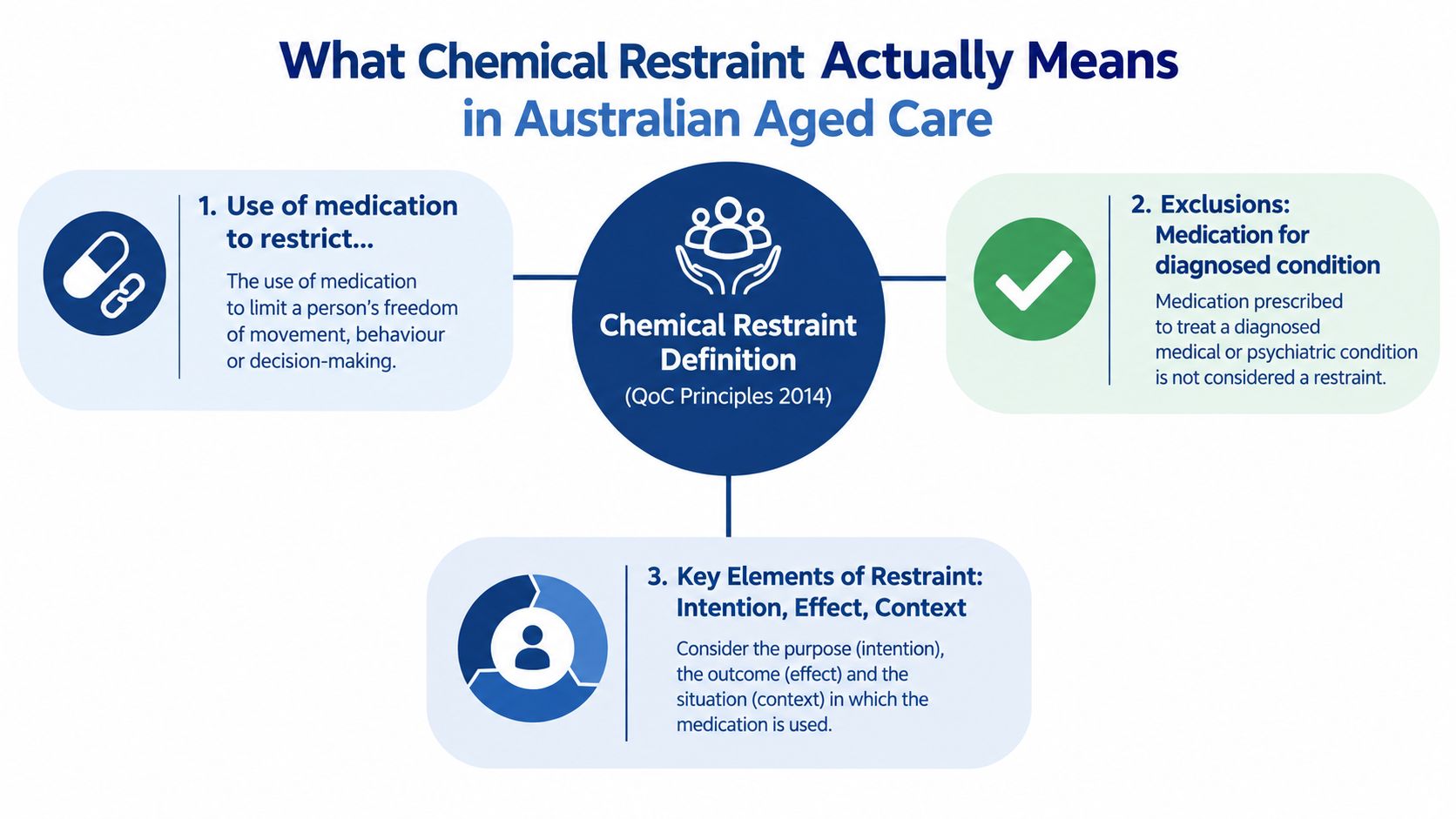
Australian guidance defines chemical restraint as a medication or chemical substance used for the primary purpose of influencing a person's behaviour. The definition excludes medication prescribed to treat a diagnosed mental disorder, physical illness or physical condition, as well as medication used for end of life care. The Independent Review of the legislative provisions governing restraint explains why this distinction matters: clinically indicated treatment isn't automatically restrictive practice.
The definition turns on three connected questions:
- What was the intention? Was the medication prescribed to treat a diagnosed condition, or to influence behaviour?
- What was the effect sought? Was the expected benefit relief of psychosis, severe anxiety, pain or another condition, or sedation and reduced resistance?
- What was the context? Was the medication clinically necessary, proportionate, consented to, documented, monitored and reviewed?
A medicine can be prescribed lawfully and still be chemical restraint if its primary purpose is behavioural control. The Aged Care Quality and Safety Commission overview of restrictive practices states that the definition can include prescribed medicines, PRN medicines and over the counter medicines. Complementary medicines can also fall within the definition when they're used to influence, moderate or control behaviour.
Drug classes and the grey zone
Antipsychotics are the obvious example, but they aren't the only medicines that require scrutiny. Benzodiazepines, sedating antidepressants, anxiolytics, hypnotics, antimanic medicines and anticholinergic medicines may become chemical restraint when the purpose is to control behaviour rather than treat a condition. The Commission's decision making tool for a restraint free environment is useful because it focuses on purpose and circumstances, not on a banned list of medications.
Off label prescribing in dementia creates a genuine grey zone. A resident may have severe distress, hallucinations or agitation associated with dementia, and an antipsychotic may be considered after other responses fail. That doesn't make every prescription restraint. It does mean the record needs to show the clinical symptom being treated, the risks and benefits considered, the consent pathway, the alternatives attempted and the plan for review.
PRN frequency and timing also matter. A dose given during a clearly documented episode of severe psychosis may have a different clinical rationale from a dose administered every night before difficult personal care. Timing doesn't prove restraint, but a repeated pattern can reveal that the medication's practical function is to make a situation more manageable for staff.
The Australian Government guidance on restrictive practices as a last resort reinforces the central test: other options should be tried first, and any restraint should be the least restrictive option for the shortest necessary period.
The Legal, Ethical and Clinical Frameworks You Need to Navigate
Chemical restraint decisions sit across several governance layers. Practitioners get into difficulty when they treat one layer as if it answers all the others.
The Aged Care Act 1997 and the Quality of Care Principles 2014 provide the aged care regulatory framework. They establish the definition, last resort requirement, consent expectations, behaviour support planning and monitoring obligations. The framework doesn't turn a facility policy into law. A local policy can add steps, but it can't reduce the legal standard.
The National Aged Care Mandatory Quality Indicator Program adds a measurement layer. Psychologists should understand what a quality indicator can and can't demonstrate. The Australian Government's Residential Aged Care Quality Indicators material states that its restrictive practices indicator records restrictive practices except chemical restraint. Public quality data therefore can't provide a complete national picture of chemical restraint use.
State and territory restrictive practice regimes may also affect the work, particularly where a psychologist is working across disability and aged care systems or where a resident has an NDIS connection. Don't assume that an NDIS style framework automatically governs every residential aged care decision. Check the jurisdiction, the resident's service arrangements and the facility's legal advice.
Finally, AHPRA and PsyBA standards bind the individual practitioner. A psychologist who assesses behaviour, advises on a behaviour support plan or participates in a restraint review remains responsible for practising within competence, documenting reasoning, managing conflicts and seeking supervision when the case exceeds their expertise. The ethical duties don't disappear because a prescriber signs the medication chart.
| Framework | What it requires | Who it binds | Key instrument |
|---|---|---|---|
| Aged care legislation | Last resort use, consent, planning, monitoring and review | Providers and relevant decision makers | Aged Care Act 1997 and Quality of Care Principles 2014 |
| Quality indicator reporting | Defined reporting of selected quality measures | Residential aged care services | National Aged Care Mandatory Quality Indicator Program |
| State and territory restrictive practice laws | Jurisdiction specific safeguards and authorisations where applicable | Services and practitioners within scope | Relevant state or territory legislation |
| Professional regulation | Competent, ethical, documented and supervised practice | Psychologists and other registered practitioners | PsyBA Code of Ethics and AHPRA requirements |
The psychologist's ethical role in restrictive practices in aged care is not to rubber stamp a prescription or to act as an informal substitute decision maker. It is to contribute behavioural assessment, formulation, alternatives, monitoring and review while keeping the resident's rights central.
Ethics committee review can help where clinical, legal and family views diverge, but it doesn't replace the required consent or authorisation process. Nor does a family preference settle the matter if the resident has decision making capacity and expresses a different view. Capacity, substitute decision making, advance care directives and the behaviour support plan need to be considered together, with the decision trail recorded clearly.
Distinguishing Treatment From Restraint at the Bedside
A useful bedside test starts before anyone reaches for the medication chart. The four questions below won't replace a prescriber's assessment, but they can expose a weak rationale quickly.
Start with the therapeutic purpose
Ask: What diagnosed condition or clinically assessed symptom is this medication treating?
“Agitation” isn't enough on its own. The record should identify the symptom, its severity, its impact and the treatment target. A resident with delirium, psychosis or severe anxiety may require medication, but the clinician needs to distinguish those conditions from distress that follows pain, fear, overstimulation or an unmet need.
Next ask whether the treatment plan matches the administration. A medication prescribed for a defined indication shouldn't become a general response to calling out, care refusal or staff workload. If the PRN instruction is broad, the team should seek clarification rather than fill the gap with habit.
Test consent and proportionality
The resident's informed consent, or the lawful substitute decision maker's authority where the resident lacks capacity, must be current and relevant to the proposed treatment. An old medication consent form may not explain a new behavioural use, a changed dose or a different risk profile.
The dose and timing also need clinical justification. A lower effective dose, a defined duration and an explicit review plan support treatment. They don't prove it, but they make the reasoning testable. A pattern of administration before predictable care tasks, without a documented medical indication, points in the other direction.
Check what happened before the medicine
The final question is practical: what non pharmacological strategies were attempted, and what did staff learn from them? A behaviour support plan should connect the intervention to the resident's history, preferences, communication style and likely triggers. The rights of medication administration guidance is also relevant to psychologists who contribute to multidisciplinary medication discussions, because administration rights don't remove the need for purpose, consent and review.
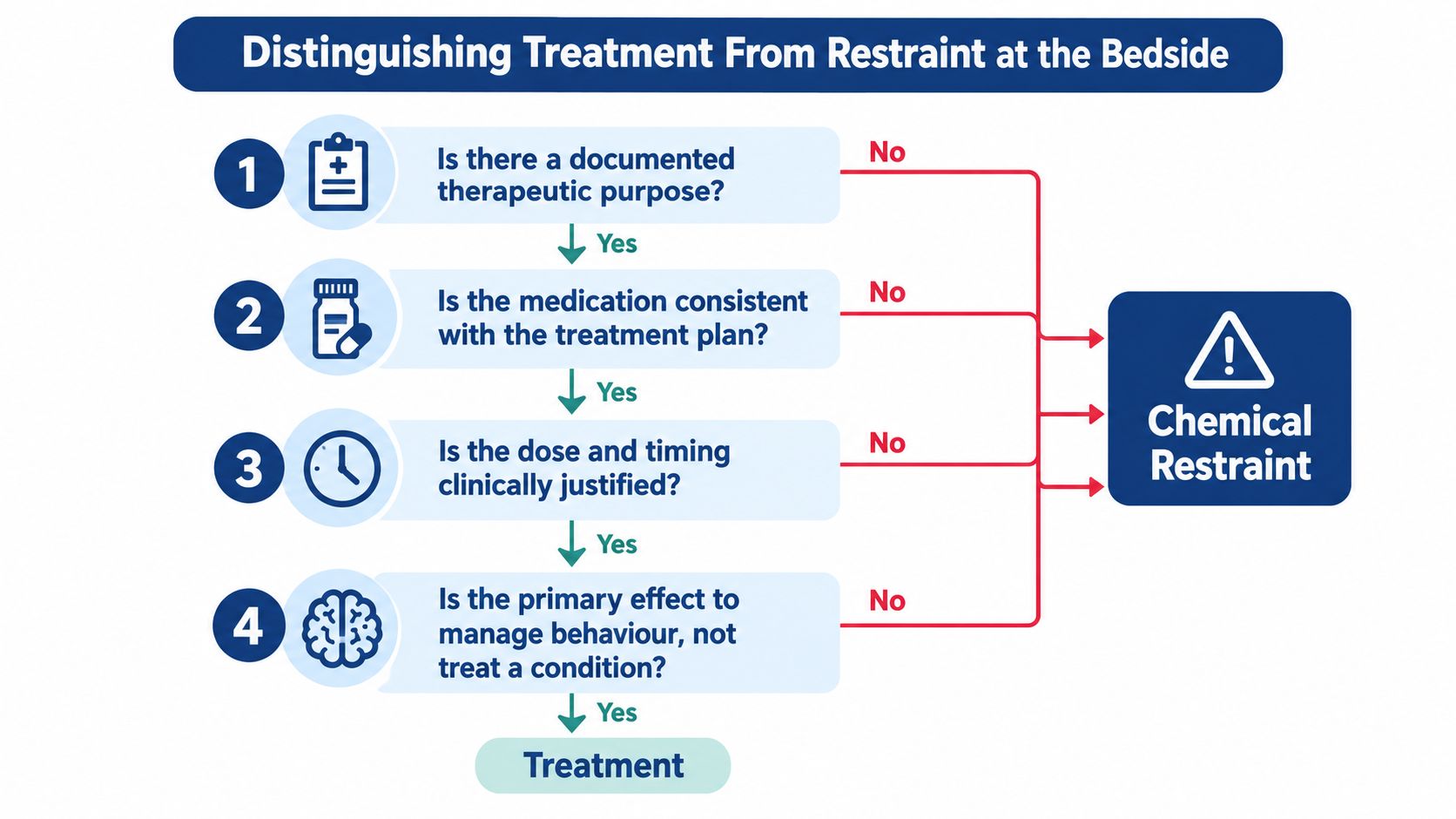
A two minute check can run like this:
- Name the condition or symptom.
- Confirm consent and plan alignment.
- Identify alternatives already tried.
- Check dose, timing, monitoring and review.
- If the primary effect is behaviour control, stop and escalate it as possible chemical restraint.
For antipsychotic use in dementia, avoid false certainty. The right question isn't whether the medicine is ever permissible. It's whether this resident, at this point, has a documented clinical need that outweighs the risks and whether the team has used the least restrictive defensible response.
Non Pharmacological Alternatives and Risk Reduction Strategies
Non pharmacological care isn't a softer version of medication. It is the assessment process that tells the team what the behaviour means and whether medication is addressing the actual problem.
Start with the antecedent. Record what happened immediately before the distress, who was present, what the resident was being asked to do, the environment, time of day and the resident's response. “Aggressive at lunch” offers little direction. “Pushed staff away when approached from behind in a noisy dining room” suggests a different intervention.
Match the response to the trigger
| Trigger | First Line Strategy | Evidence Strength | Clinician Action |
|---|---|---|---|
| Pain or physical discomfort | Pain assessment, medical review and comfort measures | Strong clinical rationale, with effectiveness dependent on accurate assessment | Ask what changed, record the assessment and communicate the response |
| Delirium or acute change | Medical assessment, medication review and treatment of the underlying cause | Strong rationale because the cause may be reversible | Escalate sudden change rather than labelling it as dementia behaviour |
| Noise, glare or disorientation | Adjust lighting, reduce noise and improve wayfinding cues | Practical and person centred, though response varies | Test one environmental change and record the result |
| Boredom or loss of role | Meaningful activity linked to the resident's history | Variable, but often clinically useful | Use the resident's interests, not generic activity schedules |
| Sensory need or anxiety | Music, aromatherapy, doll therapy or robotic pets where acceptable to the resident | Variable and individualised | Offer, observe and respect refusal |
| Repeated distress patterns | Dementia Care Mapping or the Describe, Investigate, Create, Evaluate approach | Useful formulation frameworks, requiring trained application | Use the findings to revise the behaviour support plan |
The individualised activities guidance for people living with dementia is more useful than a list of activities detached from the resident's identity. A familiar task, a preferred song or a predictable staff approach may reduce distress, but staff need to document whether it worked for this person in this situation.
Clinical alternatives still require risk management. Review polypharmacy, falls risk and anticholinergic burden. Check whether a sedating medicine is worsening mobility, alertness, swallowing, continence or communication. A deprescribing discussion should be triggered by persistent lack of benefit, adverse effects, a changed diagnosis, repeated PRN use without a clear target or a review that no longer supports continuation.
The evidence for sensory interventions and activity programmes is not uniform, and promotional claims often exceed what a particular intervention can deliver. That isn't a reason to abandon them. It is a reason to use them as monitored trials, with a clear target and an honest record of the outcome.
A defensible pharmacological plan comes after this work, not instead of it. If staff haven't investigated pain, delirium, environmental stress and communication needs, they may be treating the visible behaviour while leaving the cause untouched.
Documentation, Supervision and Audit Ready Records
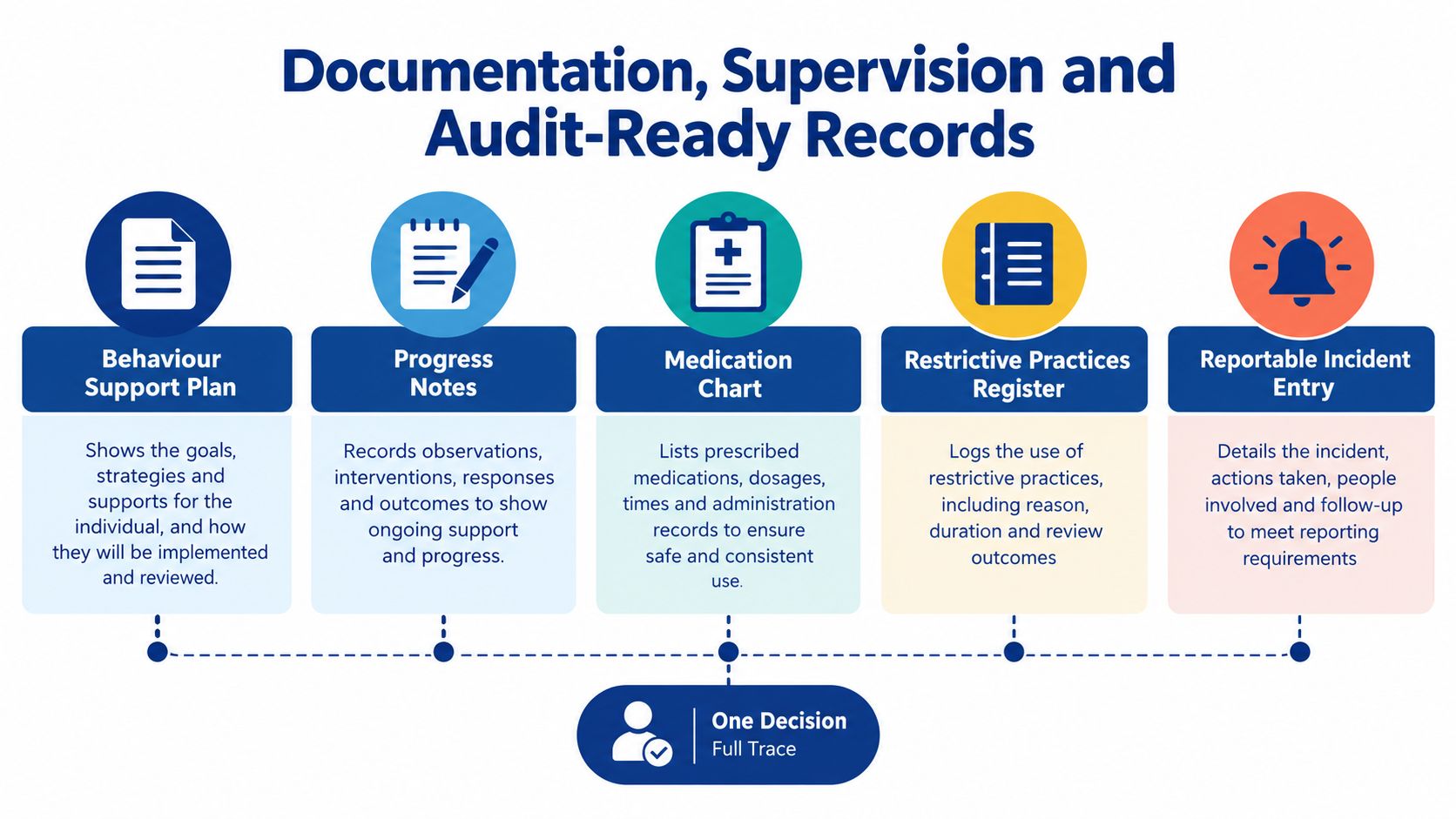
A chemical restraint decision leaves a trail. An external reviewer will often understand the case by comparing that trail across the behaviour support plan, progress notes, medication chart, restrictive practices register and any Serious Incident Response Scheme entry. Contradictions between those records can be more damaging than an imperfect clinical decision that was thoroughly assessed and reviewed.
The behaviour support plan should describe the behaviour in observable terms, identify likely triggers and set out alternatives. Progress notes should then show what happened on the day, what staff tried, who was contacted and how the resident responded. The medication chart must match the rationale, dose, route and timing. The register should reflect the restrictive practice decision where the medication meets the definition.
What the record should make visible
An audit ready entry answers five questions without forcing the reviewer to reconstruct the event:
- What happened? Describe the trigger, behaviour, frequency, severity and immediate risk.
- What was tried first? Record the non pharmacological response and the time it occurred.
- Who authorised the medicine? Identify the prescriber's rationale and the resident's consent or substitute decision maker pathway.
- What was given? Include the medication, dose, route and administration time.
- What happens next? State the monitoring, review point, taper or cessation plan and escalation pathway.
Avoid retrospective phrases such as “settled after medication” without describing the observed change. Sedation, reduced movement and silence may be effects, but they don't establish therapeutic success. Record alertness, distress, participation, falls risk and other relevant outcomes.
The review loop needs a named owner. The team should specify what will be reviewed within the immediate period after administration, what will be reconsidered at the short term clinical review, and when the prescriber will decide whether to taper or cease. If a local policy uses particular review intervals, follow it. Don't present an invented interval as a universal legal rule.
Supervision is part of governance
Psychologists, registrars and endorsed practitioners should bring restraint cases to supervision with the formulation, not just the incident. The supervisor should be able to see the antecedent analysis, capacity and consent questions, alternatives attempted, communication with nursing and medical staff, and the ethical tension that remains.
A good supervision record captures the advice given and the action taken. It also identifies when the psychologist needs consultation from a geriatrician, pharmacist, behaviour support specialist, facility clinical governance lead or legal adviser. Supervision isn't a retrospective approval mechanism. It should influence the next assessment and reduce the chance that repeated PRN use becomes invisible.
For the external reviewer, the first concern is usually coherence. Does the medication indication match the behaviour support plan? Does the consent trail match the intervention? Do the progress notes show least restrictive practice? Do the review entries demonstrate that someone actively considered stopping?
Case Examples From Residential Aged Care
The same medication can look like treatment in one record and restraint in another. The difference lies in purpose, assessment, consent and the review loop.
Quetiapine PRN for a resident with Lewy body dementia
A resident with Lewy body dementia becomes frightened during personal care and sometimes reports visual experiences that staff find difficult to interpret. Quetiapine is prescribed PRN, but the chart says only “for agitation”. The notes don't identify the symptoms being treated, and there's no record of environmental adjustment, a preferred staff approach, pain assessment or a non pharmacological trial.
The problem isn't just that quetiapine was prescribed PRN. The record fails to show a therapeutic target or why this response was proportionate. It also fails to demonstrate that the team considered the resident's particular vulnerability to medication effects. A restraint review would reasonably ask whether the primary purpose had become making personal care easier.
A stronger record would describe the episode, document the assessment, identify the prescriber's indication, confirm consent and set out a time limited review. It would also record what staff should try before returning to medication.
Haloperidol during delirium superimposed on dementia
Another resident with dementia develops an abrupt change in attention, sleep, perception and behaviour during an acute illness. The medical team documents suspected delirium, investigates the cause, records the immediate safety concern and prescribes haloperidol for a narrowly defined clinical purpose. The order includes monitoring and a plan to review and cease it as the delirium resolves.
Here, the notes support treatment of an acute medical syndrome rather than routine behaviour control. That doesn't remove the need for caution, consent, monitoring or review. It does show why the legal exclusion for medication prescribed to treat a diagnosed physical or mental condition matters.
The clinical timeline is the important feature. Without it, the same drug could remain on the chart after the acute condition resolves and gradually become a general response to distress.
Behaviour expressing an unmet need
A third resident repeatedly pushes staff away during transfers and shouts when approached. The initial notes describe “aggression”, and an antipsychotic is being considered. A psychologist observes the transfer, notices facial grimacing and reviews the resident's pain history. The medical team identifies untreated pain, the care plan changes the transfer method and analgesia is reviewed, and the behaviour reduces without the proposed psychotropic.
This case demonstrates the value of formulation. The behaviour was information about an unmet need, not proof of a psychiatric disorder. The record succeeds because it links observation to assessment, changes the intervention and documents the outcome.
A useful question for supervision: If the medication were removed from the record, would the formulation still explain what the resident was communicating?
In each case, proportionality depends on the whole sequence. A signed prescription can't compensate for a missing assessment. A family's agreement can't replace a clear clinical purpose. A behaviour support plan can't be treated as a static form if staff aren't using it to guide and evaluate care.
A Practitioner Checklist You Can Use Tomorrow
Use this checklist during the next handover, PRN discussion or supervision session. It's designed to catch the decision before the record turns a temporary response into an established routine.
Before any PRN is administered
- Identify the purpose: What diagnosed condition or specific symptom is the medicine intended to treat?
- Check the resident's voice: Is consent current, and does the advance care directive or substitute decision maker information affect the decision?
- Review the plan: Does the medication match the behaviour support plan and prescriber's documented indication?
- Assess the cause: Has anyone considered pain, delirium, constipation, infection, medication effects, fear, sensory loss or environmental overload?
- Check alternatives: Which person centred responses were attempted, when were they attempted and what happened?
- Confirm escalation: Who must be contacted if the behaviour persists, worsens or suggests immediate clinical risk?
At the point of administration
- Record the event: Describe what the resident did and the immediate risk without relying on labels such as “challenging”.
- Confirm the order: Check medication, dose, route, timing and the reason the prescriber authorised it.
- Name the least restrictive option: If the main expected effect is sedation or behavioural control, pause and escalate rather than treating the medicine as routine.
- Communicate clearly: Make sure the next shift knows what was tried, what was given and what must be reviewed.
Within the review period
- Observe more than calm: Record alertness, distress, communication, mobility, participation and adverse effects.
- Compare with the target: Did the treatment improve the documented symptom, or did it merely reduce activity?
- Update the plan: If the cause was medical, address it. If the medicine wasn't beneficial, discuss tapering or cessation with the prescriber.
- Complete the governance trace: Update the relevant notes, plan, register and incident process according to the service's requirements.
At the behaviour support plan audit
- Look for patterns: Review repeated PRN use, timing around care tasks and changes in frequency or severity.
- Test consent: Check that authorisation still reflects the current medication, purpose and circumstances.
- Challenge convenience: Ask whether staffing routines or environmental conditions are shaping medication use.
- Bring the case to supervision: Present the formulation, alternatives, ethical concern and proposed next step, not just the medication history.
Documentation platforms, behaviour support plan templates and supervision logs can help make these decisions traceable rather than memory dependent. PracticeReady is one option for psychologists who need structured records for supervision, CPD and audit preparation, although it doesn't replace the aged care provider's clinical systems, medication governance or legal obligations.
The practical takeaway is simple: before you support, administer or endorse a PRN response, write one sentence naming the condition being treated, one sentence describing the alternatives attempted and one sentence stating when the decision will be reviewed. If those sentences can't be written, the case needs a fuller assessment before the next dose.
If chemical restraint decisions are exposing gaps in your supervision or compliance records, PracticeReady can help you keep structured supervision notes, clinical governance records and audit ready professional documentation in one place. Visit PracticeReady to see how its workflows can support the record keeping around complex aged care practice.