Occupational Therapy CPD in Australia Made Simple
Renewal is a few weeks away. You've done plenty of learning this year, but the proof is scattered across your inbox, a notebook and a folder you haven't opened since March. Occupational Therapy CPD, or continuing professional development, supports your practice and meets a formal Australian registration obligation. It is more than a drawer of attendance certificates.
What Occupational Therapy CPD Means in Australia
If you work alongside occupational therapists, this distinction matters. A shared workshop may address the same client needs for both of you, but each profession answers to its own registration requirements. The rules are not interchangeable.
For occupational therapists, the registration standard provided through Ahpra sets a minimum of 20 hours each registration year for practitioners it covers. The learning must relate to your scope of practice and contribute to better patient outcomes, safety and experiences.
The useful question isn't just "Did I attend?" It's "What did I learn, and why does it matter to my work?"
Think of your CPD record as a pilot's logbook. Certificates in a drawer are scattered receipts. A logbook ties each entry to a date, a duration and a purpose.
Check the Core CPD Requirements
The registration standard is where you confirm what you owe. Four points cover most of what an audit would probe:
- Annual minimum: Complete at least 20 hours during each registration year.
- Who is excluded: Student and non practising registrants are excluded.
- Relevance test: Connect learning to your scope and to improved patient outcomes, safety and experiences.
- Defensible record: Keep activity details, dates, duration, reflections and supporting evidence together.
Organise each entry around three questions:
- What happened? Name the activity and record when it took place.
- What was learned? Describe the specific insight, not the session title.
- Why is it relevant? Spell out the connection to your clinical responsibilities.
Consider an occupational therapist in a shared mental health service who completes training on daily routines. They might link that learning to participation goals discussed with a psychologist colleague. The written explanation makes the relevance visible without implying both professions follow identical rules.
Start With Evidence You Can Find

Treat Ahpra as your regulatory starting point. A training provider's certificate shows you attended. It cannot stand in for every element of the standard.
If you are comparing renewal systems across professions, Be Your Best Self & Thrive's guide offers useful context, though it does not replace the Australian occupational therapy requirements.
The Board expects evidence, not just effort. For today, pick one recent activity, gather its evidence and write a short relevance statement.
You remember attending the training. What is fuzzier is whether those hours fall inside this registration year. Check the period you are counting against before booking another session.
Meeting the 20 Hour Annual Requirement
Practitioners with practising registration need at least 20 hours each registration year. The learning must sit within their scope and contribute to better patient outcomes, safety and experiences.
If registration starts part way through a period, the requirement is calculated on a pro rata basis: five hours for every three months remaining. The detail is in AHPRA's CPD registration standard.
Students and non practising registrants sit outside that obligation. Check each person's registration status rather than assuming everyone in a shared session is working to the same target.
Count against the practitioner's registration period, not your clinic's training calendar.
Work Through a Final Quarter Example
Take an occupational therapist who joins a mental health service with three months left in their registration period. Their minimum for what remains is five hours, not the full annual amount.
They could spread the learning across those months rather than cramming it into the first fortnight. For example, two hours in September, two in October and one in November. These figures are illustration only. They are not prescribed quotas.

Starting at a clinic and becoming registered are different events. An established practitioner changing employers should not treat a new job start date as the opening of a fresh regulatory period.
If your team spans several professions, the guide to physiotherapy continuing professional development is a useful separate comparison. Keep each profession's rules distinct when planning shared education.
Treat the Minimum as a Starting Point
The number tells you how much learning is required. It says nothing about why that learning belongs in your record. Before you call an entry complete, ask:
- What did I complete?
- When did the learning occur?
- How long did it take?
- Why did it matter to my practice?
You do not need an elaborate narrative. You do need enough detail to separate a relevant learning activity from an unexplained number in a spreadsheet.
For psychology-specific CPD records, you can compare PracticeReady with the system you currently use.
Many occupational therapists lose valid hours to one assumption: if it had no certificate, it does not count. The learning happened, but it never reaches the record because there was no attendance email or PDF at the end.
A better way to think about CPD is as a toolbox, not a course catalogue. For any activity, ask whether it helps you serve clients more safely, thoughtfully or effectively.

The Range of Activities That Can Count
Formal workshops are one tool among many. Conferences, clinical supervision, peer discussion, reflective writing and self directed study can all count when they connect to your scope of practice. Each leaves a different trail:
- Formal courses and workshops: certificate or statement of attendance with hours listed.
- Conferences: registration confirmation, program and a note of sessions attended.
- Clinical supervision: dated supervision records or a signed log.
- Peer discussion groups: a short note of participants, topic and duration.
- Reflective practice: written reflection tied to a specific learning outcome.
- Self directed learning: reading notes, summaries or completed modules.
An activity without evidence is like a tool left in the shed. Nobody can see it, so it cannot be counted when it matters.
The Misconception That Costs the Most Hours
Reading a journal article or sitting through a routine team meeting does not automatically become occupational therapy CPD. The gap is usually the missing link between what happened and what changed.
The relevance test asks whether the learning connects to your scope and contributes to better patient outcomes, safety and experiences. A meeting about office parking will struggle. A meeting about a new discharge planning process can pass, provided you record what you learned and how it changed your practice.
The fix is one sentence that joins the activity to a real part of your clinical work. For example: "I read a research summary on sensory strategies for school aged children, and I am applying two recommended regulation techniques with my paediatric clients this term."
If you organise or attend structured education sessions, this education solutions page offers classroom audience response solutions that make professional learning more interactive and easier to document.
Why Planning Beats Panic
Most CPD trouble comes from learning that happens in the wrong order, with no plan tying it to the record until year end. The work was real, but it becomes invisible until someone reconstructs it from memory and calendar debris.
A light annual plan solves most of this. Look across the coming year. What does your caseload suggest? Which skills do you want to strengthen?
Turn those themes into two or three learning goals. A modest plan you actually use will carry you further than an impressive one abandoned by March. Then match each goal to a mix of activities, so one October conference is not responsible for saving the whole year.
For a structured way to work out what your team needs, read our guide on training needs analysis before committing to bookings.
A Rhythm You Can Actually Keep
Two small routines do most of the heavy lifting:
The monthly five minute check. Log activities as they happen, or at month's end at the latest. Record the date, duration, activity type, one sentence of relevance and the evidence file.
The quarterly review. Every three months, ask:
- Am I on track for the hours?
- Am I covering a sensible mix of activity types?
- Does every entry carry a relevance statement that would survive scrutiny?
If any answer is no, there is still time to fix it. That is the value of the quarterly check: it turns a looming renewal crisis into a small course correction.
Building a Record That Stands Up to Audit
Think of your CPD portfolio like the paper trail behind a home loan application. A payslip somewhere in your inbox is technically proof of income, but the assessor shouldn't have to hunt for it.
A defensible record connects the activity, the learning and the evidence without asking someone to reconstruct your year.
The occupational therapy workforce has grown considerably, reaching 28,844 registered occupational therapists at 30 June 2023. That national figure gives context, but it says nothing about which recording system works best. See Ahpra's occupational therapy registration figures.
Connect Every Entry to Its Evidence
Fragmentation is the real problem, not the spreadsheet. Build each entry around these core fields, using the same labels every time:
- Date and duration: when the activity happened and how much learning time you recorded.
- Activity type: the format, such as supervision, reading or a workshop.
- Learning category: where the activity sits against your plan.
- Relevance reflection: what you learned and how it connects to your scope.
- Supporting evidence: a direct link to the certificate, notes or other documentation.
Treat this as a practical recording structure, not a substitute for the occupational therapy CPD registration standard itself.
Match Documents to What They Demonstrate
Different documents answer different questions. A booking receipt shows you registered. It does not prove you attended, and it says nothing about what you took away.
Evidence Types for a Defensible CPD Record
| Evidence Type | What It Proves | Where to Store It |
|---|---|---|
| Attendance certificate | Recorded participation and any stated hours | Attached to the activity entry |
| Session programme | Topics and scheduled session length | Beside attendance evidence |
| Supervision log | Date, duration and discussion themes | Linked to the relevant entry |
| Reading notes | Your documented engagement and learning | Within the activity record |
| Reflection | Your explanation of relevance and intended application | Alongside supporting documents |
No single document does everything. Name files consistently, using the activity date plus a recognisable title. Keep client identifying information out of your learning notes entirely.
For a broader look at how evidence gets checked, the guide to audit and assurance is worth reading.
Close the Loop Each Month
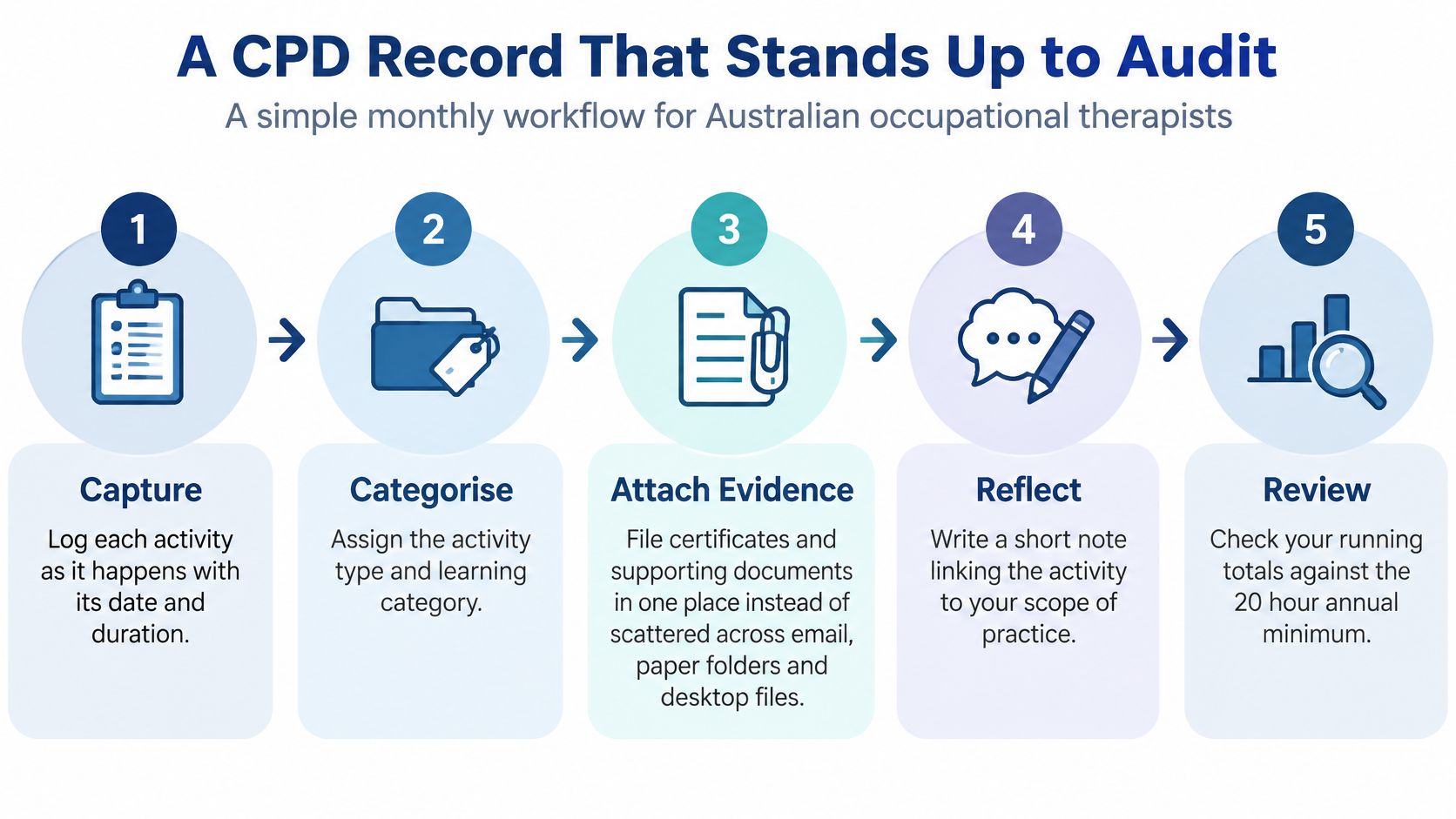
Keep evidence and reflection connected while the details are fresh:
- Capture dates and duration.
- Categorise the activity type and learning category.
- Attach evidence where you will find it later.
- Reflect on relevance.
- Review totals against the 20 hour annual minimum, and check any adjusted obligation against the standard.
Start with this month's entries. Repair missing attachments first, then add new activities to a clean record.
See a Worked Example
"Attended sensory workshop, 3 hours" feels clear on the day. Six months later, it does not say who ran the training, what shifted in your thinking, or why it mattered for a client.
The examples below are fictional illustrations, not approved entries and not a promise of compliance. Check them against the occupational therapy CPD registration standard.

Before
Attended sensory workshop, 3 hours.
After
- Activity and provider: Sensory processing workshop delivered by Example Paediatric Education, a fictional provider.
- Date and duration: 12 March 2026, 3 hours of learning.
- Activity type: Workshop.
- Learning category: Sensory assessment and school participation.
- Evidence: Attendance certificate, programme and learning notes.
Reflection: "I learned to look closely at classroom demands before choosing sensory strategies for a school based client experiencing distress. I then discussed environmental adjustments with the teacher and treating psychologist, and we agreed to review participation rather than assume the strategy had helped."
Make Peer Discussion Learning Visible
Peer discussion holds real learning, but "discussed case" tells an auditor almost nothing about why the conversation mattered.
Before
Peer meeting with psychologist, 1 hour.
After
| Field | Illustrative Entry |
|---|---|
| Date and duration | 19 March 2026, 60 minutes |
| Participants | Alex Morgan, occupational therapist, and Priya Shah, psychologist, both fictional |
| Learning focus | Understanding avoidance, fatigue and difficulties starting everyday routines |
| Activity type | Peer discussion |
| Learning category | Mental health participation |
| Evidence | Dated learning summary and agreed action notes |
Reflection: "The discussion challenged my assumption that missed routines mainly reflected organisational difficulties. I changed my assessment questions to explore distress and fatigue, while coordinating with the psychologist about our respective roles."
Record what changed in your thinking, not just who was in the room.
Copy This CPD Entry Template
For occupational therapy CPD, use this template as a recording aid, not a substitute for the Board's registration standard.
- Activity details: title, provider or participants, date, duration and activity type.
- Learning connection: your learning goal, planning category and relevance to your scope.
- Reflection prompt: What did I learn, which assumption changed, and what will I review differently?
- Evidence checklist: attendance confirmation, programme, discussion summary or learning notes.
- Follow through: the intended action and a review date where useful.
Before saving, make sure your reflection separates planned action from work already completed. Then repair one recent entry using these fields.
Few occupational therapists manage their CPD entirely alone. Supervisors and practice managers share responsibility for keeping teams compliant, yet that oversight often only appears when renewal is close.
Why CPD Belongs in Workforce Support
Ahpra's 2024 occupational therapy workforce survey drew 6,006 completed responses, and 86 percent of respondents planned to stay in the profession. Among those thinking about leaving within five years, the main reasons were mental burnout, falling professional satisfaction and feeling undervalued. The full picture is in the 2024 occupational therapy workforce findings.
A learning plan that builds confidence and connects to meaningful work can ease the pressures that push people out. Well organised CPD is part of keeping people sustainably in the job.
Questions for a Regular Catch Up
A brief catch up every month or two is usually enough to spot gaps early:
- Which learning goals are you working towards this year?
- What have you logged since we last spoke?
- Where are the gaps between your plan and your record?
- Which activity has recently changed how you work with clients?
Sharing Progress Without Chasing Paperwork
A useful team summary shows:
- Hours against the 20 hour annual minimum
- Activity mix across courses, supervision and peer discussion
- Relevance statements completed for each entry
- Missing evidence flagged before it becomes a renewal problem
A summary that is ready when someone asks saves more time than any reminder email.
Frequently Asked Questions
Do part time practitioners still need 20 hours? Yes, if you hold practising registration. The 20 hour minimum applies to the registration year, not to the days you work. If you registered part way through the period, the pro rata rule applies: five hours for every three months remaining.
Does reflective practice count on its own? It can, but only when it is documented and linked to a learning outcome. Write down what you learned, how it changed your work and which goal it supports.
How long should you keep CPD records? Keep your evidence at least until your next audit window closes. Check current Board guidance before deciding, because timeframes do change.
Your One Page CPD Checklist
- Annual minimum: 20 hours in each registration year, with pro rata hours for part way registration.
- Relevance test: Does this link to my scope and to better patient outcomes, safety and experiences?
- Evidence fields: date, duration, activity type, learning category, relevance reflection, attached evidence.
- Monthly review: Log activities as they happen and check totals against the minimum.
Print it, stick it in your planner and tick one box today. Start with the item that feels least certain, because that is usually where the real learning is.
If you want a calmer way to keep these records in good order, PracticeReady offers structured CPD tracking with a clear progress dashboard.